
Application Provision

1
Application and Definitions
1.1
This Part applies to:
- (a) a firm that is a CRR firm; and
- (b) a CRR consolidation entity.
- 01/01/2022
- Legal Instruments that change this rule 1.1
1.2
In this Part, the following definitions shall apply:
means a distribution of market values or exposures at a future time period where the distribution is calculated using historical or realised values such as volatilities calculated using past price or rate changes.
[Note: This rule corresponds to Article 272(16) of the CRR as it applied immediately before revocation by the Treasury]
means the value calculated as:
- (a) the exposure value of the netting set as at 1 January 2027 using the formula in Article 274(2) where α = 1.4; less
- (b) the exposure value of the netting set as at 1 January 2027 using the formula in Article 274(2) where α = 1.
contractual cross product netting agreement
means a bilateral contractual agreement between an institution and a counterparty which creates a single legal obligation (based on netting of covered transactions) covering all bilateral master agreements and transactions belonging to different product categories that are included within the agreement.
For the purposes of this definition, ‘different product categories’ means:
- (1) repurchase transactions, securities and commodities lending and borrowing transactions;
- (2) margin lending transactions;
- (3) the contracts listed in Annex 1 of Chapter 3 of this Part.
[Note: This rule corresponds to Article 272(25) of the CRR as it applied immediately before its revocation by the Treasury]
counterparty credit risk or CCR
means the risk that the counterparty to a transaction could default before the final settlement of the transaction's cash flows.
[Note: This rule corresponds to Article 272(1) of the CRR as it applied immediately before its revocation by the Treasury]
means the inclusion of transactions of different product categories within the same netting set pursuant to the cross-product netting rules set out in this Part.
[Note: This rule corresponds to Article 272(11) of the CRR as it applied immediately before its revocation by the Treasury]
means the larger of zero and the market value of a transaction or portfolio of transactions within a netting set with a counterparty that would be lost upon the default of the counterparty, assuming no recovery on the value of those transactions in insolvency or liquidation.
[Note: This rule corresponds to Article 272(17) of the CRR as it applied immediately before its revocation by the Treasury]
means the net market value of all the transactions within a netting set gross of any collateral held or posted where positive and negative market values are netted in computing the CMV.
[Note: This rule corresponds to Article 272(12) of the CRR as it applied immediately before revocation by the Treasury]
means the forecast of the probability distribution of market values that is generated by setting forecast instances of negative net market values equal to zero.
[Note: This rule corresponds to Article 272(14) of the CRR as it applied immediately before its revocation by the Treasury]
means the forecast of the probability distribution of net market values of transactions within a netting set for a future date (the forecasting horizon), given the realised market value of those transactions at the date of the forecast.
[Note: This rule corresponds to Article 272(13) of the CRR as it applied immediately before its revocation by the Treasury]
effective expected exposure at a specific date or Effective EE
means the maximum expected exposure that occurs at that date or any prior date. Alternatively, an institution may define it for a specific date as the greater of the expected exposure at that date or the effective expected exposure at any prior date.
[Note: This rule corresponds to Article 272(20) of the CRR as it applied immediately before its revocation by the Treasury]
effective expected positive exposure or Effective EPE
means the weighted average of effective expected exposure over the first year of a netting set or, if all the contracts within the netting set mature within less than one year, over the time period of the longest maturity contract in the netting set, where the weights are the proportion of the entire time period that an individual expected exposure represents.
[Note: This rule corresponds to Article 272(22) of the CRR as it applied immediately before its revocation by the Treasury]
under the Internal Model Method for a netting set with maturity greater than one year means the ratio of the sum of expected exposure over the life of the transactions in the netting set discounted at the risk-free rate of return, divided by the sum of expected exposure over one year in the netting set discounted at the risk-free rate.
This effective maturity may be adjusted to reflect rollover risk by replacing expected exposure with effective expected exposure for forecasting horizons under one year.
[Note: This rule corresponds to Article 272(10) of the CRR as it applied immediately before its revocation by the Treasury]
means the average of the distribution of exposures at a particular future date before the longest maturity transaction in the netting set matures.
[Note: This rule corresponds to Article 272(19) of the CRR as it applied immediately before its revocation by the Treasury]
expected positive exposure or EPE
means the weighted average over time of expected exposures, where the weights are the proportion of the entire time period that an individual expected exposure represents.
When calculating the own funds requirement, institutions shall take the average over the first year or, if all the contracts within the netting set mature within less than one year, over the time period until the contract with the longest maturity in the netting set has matured.
[Note: This rule corresponds to Article 272(21) of the CRR as it applied immediately before its revocation by the Treasury]
means a group of transactions within a single netting set for which full or partial offsetting is allowed for determining the potential future exposure under the methods set out in Section 3 or 4 of Chapter 3.
[Note: This rule corresponds to Article 272(6) of the CRR as it applied immediately before revocation by the Treasury.]
means transactions where a counterparty undertakes to deliver a security, a commodity, or a foreign exchange amount against cash, other financial instruments, or commodities, or vice versa, at a settlement or delivery date specified by contract that is later than the market standard for this particular type of transaction or five business days after the date on which the institution enters into the transaction, whichever is earlier.
[Note: This rule corresponds to Article 272(2) of the CRR as it applied immediately before its revocation by the Treasury]
means an agreement or provisions of an agreement under which one counterparty must supply collateral to a second counterparty when an exposure of that second counterparty to the first counterparty exceeds a specified level.
[Note: This rule corresponds to Article 272(7) of the CRR as it applied immediately before its revocation by the Treasury]
means transactions in which an institution extends credit in connection with the purchase, sale, carrying or trading of securities. Margin lending transactions do not include other loans that are secured by collateral in the form of securities.
[Note: This rule corresponds to Article 272(3) of the CRR as it applied immediately before its revocation by the Treasury]
means the largest amount of an exposure that remains outstanding before one party has the right to call for collateral.
[Note: This rule corresponds to Article 272(8) of the CRR as it applied immediately before revocation by the Treasury.]
net independent collateral amount or NICA
means the sum of the volatility-adjusted value of net collateral received or posted, as applicable, to the netting set other than variation margin.
means a non-financial counterparty as defined in point (9) of Article 2 of Regulation (EU) No 648/2012 or an undertaking that would be a non-financial counterparty if it was established in the UK.
means a margin agreement under which an institution is required to post variation margin to a counterparty but is not entitled to receive variation margin from that counterparty or vice-versa.
means one year expressed in business days.
means the payment agreed in an OTC derivative transaction with a linear risk profile which stipulates the exchange of a financial instrument for a payment.
In the case of transactions that stipulate the exchange of payment against payment, those two payment legs shall consist of the contractually agreed gross payments, including the notional amount of the transaction.
[Note: This rule corresponds to Article 272(26) of the CRR as it applied immediately before revocation by the Treasury.]
means a high percentile of the distribution of exposures at particular future date before the maturity date of the longest transaction in the netting set.
[Note: This rule corresponds to Article 272(18) of the CRR as it applied immediately before its revocation by the Treasury]
means a counterparty referred to in point (10) of Article 2 of Regulation (EU) No 648/2012 or a counterparty that would fall within point (10) of Article 2 of Regulation (EU) No 648/2012 if it was recognised or established in the UK.
means a distribution of market values or exposures over a future time period where the distribution is calculated using market implied values such as implied volatilities.
[Note: This rule corresponds to Article 272(15) of the CRR as it applied immediately before its revocation by the Treasury]
means the amount by which EPE is understated when future transactions with a counterparty are expected to be conducted on an ongoing basis.
The additional exposure generated by those future transactions is not included in calculation of EPE.
[Note: This rule corresponds to Article 272(23) of the CRR as it applied immediately before its revocation by the Treasury]
1.3
For the purposes of Section 9 of this Part, the following definitions apply:
in relation to client assets, means that effective arrangements exist which ensure that those assets will not be available to the creditors of a CCP or of a clearing member in the event of the insolvency of that CCP or clearing member respectively, or that the assets will not be available to the clearing member to cover losses it incurred following the default of a client or clients other than those that provided those assets.
means a transaction in cash, debt instruments or equities, a spot foreign exchange transaction or a spot commodities transaction; however, repurchase transactions, securities or commodities lending transactions, and securities or commodities borrowing transactions, are not cash transactions.
means a contract or a transaction listed in Article 301(1) between a client and a clearing member that is directly related to a contract or a transaction listed in that paragraph between that clearing member and a CCP.
means a client as defined in point (15) of Article 2 of Regulation (EU) No 648/2012 or an undertaking that has established indirect clearing arrangements with a clearing member in accordance with Article 4(3) of that Regulation.
fully guaranteed deposit lending or borrowing transaction
means a fully collateralised money market transaction in which two counterparties exchange deposits and a CCP interposes itself between them to ensure the performance of those counterparties' payment obligations.
means an entity providing clearing services to a lower-level client.
means an arrangement that meets the conditions set out in the second subparagraph of Article 4(3) of Regulation (EU) No 648/2012.
means an entity accessing the services of a CCP through a higher-level client.
means an indirect clearing arrangement under which clearing services are provided to an institution by an entity which is not a clearing member, but is itself a client of a clearing member or of a higher-level client.
unfunded contribution to a default fund
means a contribution that an institution that acts as a clearing member has contractually committed to provide to a CCP after the CCP has depleted its default fund to cover the losses it incurred following the default of one or more of its clearing members.
[Note: This rule corresponds to Article 300 of the CRR as it applied immediately before revocation by the Treasury.]
1.4
For the purposes of Section 7 of Chapter 3 of this Part, ‘counterparty’ means any legal or natural person that enters into a netting agreement, and has the contractual capacity to do so.
[Note: This rule corresponds to Article 272(24) of the CRR as it applied immediately before its revocation by the Treasury]
- 01/01/2027
- Legal Instruments that change this rule 1.4
Export chapter as
2
Level of Application
2.1
A firm to which this Part applies shall comply with this Part on an individual basis.
2.2
A CRR consolidation entity must comply with this Part on a consolidated basis.
- 01/01/2027
- Legal Instruments that change this rule 2.2
2.3
An institution or CRR consolidation entity to which this Part is applied in a sub-consolidation requirement must comply with this Part on a sub-consolidated basis, as set out in that requirement.
- 01/01/2027
- Legal Instruments that change this rule 2.3
3
Counterparty Credit Risk (Part Three, Title Two, Chapter Six CRR)
Section 1 Definitions
Article 271 Determination of the Exposure Value
1.
An institution shall determine the exposure value of derivative instruments listed in Annex 1 of Chapter 3 in accordance with this Chapter.
2.
An institution that is not an SDDT or an SDDT consolidation entity may, subject to paragraph 3 of this Article, determine the exposure value of repurchase transactions, securities or commodities lending or borrowing transactions, long settlement transactions and margin lending transactions in accordance with this Chapter instead of the Credit Risk Mitigation (CRR) Part.
- 01/01/2027
- Legal Instruments that change this rule 2.
3.
An institution which has a 138BA permission to use the Internal Model Method (IMM) must determine the exposure value of repurchase transactions, securities or commodities lending or borrowing transactions, long settlement transactions and margin lending transactions that are within the scope of that 138BA permission in accordance with the method set out in Section 6 of this Chapter to the extent and subject to any modifications set out in the 138BA permission.
[Note: This rule corresponds to Article 271 of the CRR as it applied immediately before its revocation by the Treasury]
- 01/01/2027
- Legal Instruments that change this rule 3.
Article 272 Definitions
Export Article as
Section 2 Methods for Calculating the Exposure Value
Article 273 Methods for Calculating the Exposure Value
1.
Institutions that are not SDDTs or SDDT consolidation entities shall calculate the exposure value for the contracts listed in Annex 1 of this Chapter on the basis of one of the methods set out in Sections 3 to 6 in accordance with this Article.
Institutions that are SDDTs or SDDT consolidation entities shall calculate the exposure value for the contracts listed in Annex 1 of this Chapter on the basis of one of the methods set out in Sections 3 to 5 in accordance with this Article.
An institution which does not meet the conditions set out in Article 273a(1) shall not use the method set out in Section 4. An institution which does not meet the conditions set out in Article 273a(2) shall not use the method set out in Section 5.
Institutions that are not SDDTs or SDDT consolidation entities may use in combination the methods set out in Sections 3 to 6 on a permanent basis within a group. A single institution that is not an SDDT or SDDT consolidation entity shall not use in combination the methods set out in Sections 3 to 6 on a permanent basis.
Institutions that are SDDTs or SDDT consolidation entities may use in combination the methods set out in Sections 3 to 5 on a permanent basis within a group. A single institution that is an SDDT or SDDT consolidation entity shall not use in combination the methods set out in Sections 3 to 5 on a permanent basis.
2.
Where an institution is permitted by the PRA to disapply the methods set out in Sections 3 to 5 of this Chapter (if otherwise applicable) and to apply the method set out in Section 6 of this Chapter in accordance with Article 283(1), an institution that is not an SDDT or an SDDT consolidation entity shall determine the exposure value for the following items using the IMM set out in Section 6 of this Chapter:
- (a) the contracts listed in Annex 1 of this Chapter;
- (b) repurchase transactions;
- (c) securities or commodities lending or borrowing transactions;
- (d) margin lending transactions;
- (e) long settlement transactions,
to the extent and subject to any modifications set out in the 138BA permission.
3.
When an institution purchases protection through a credit derivative against a non-trading book exposure or against a counterparty risk exposure, it may calculate its own funds requirement for the hedged exposure in accordance with either of the following:
- (a) Articles 233 to 236;
- (b) in accordance with Article 183, where an institution has been granted an IRB permission.
The exposure value for CCR for those credit derivatives shall be zero, unless an institution applies the approach in point (h)(ii) of Article 299(2).
4.
Notwithstanding paragraph 3, an institution may choose consistently to include for the purposes of calculating own funds requirements for counterparty credit risk all credit derivatives not included in the trading book and purchased as protection against a non-trading book exposure or against a counterparty credit risk exposure where the credit protection is recognised under the CRR.
5.
Where credit default swaps sold by an institution are treated by an institution as credit protection provided by that institution and are subject to own funds requirement for credit risk of the underlying for the full notional amount, their exposure value for the purposes of CCR in the non-trading book shall be zero.
- 01/01/2022
- Legal Instruments that change this rule 5.
6.
Under the methods set out in Sections 3 to 6 of this Chapter, the exposure value for a given counterparty shall be equal to the sum of the exposure values calculated for each netting set with that counterparty.
By way of derogation from the first subparagraph, where one margin agreement applies to multiple netting sets with that counterparty and the institution is using one of the methods set out in Sections 3 to 6 to calculate the exposure value of those netting sets, the exposure value shall be calculated in accordance with the relevant Section.
For a given counterparty, the exposure value for a given netting set of OTC derivative instruments listed in Annex 1 of this Part calculated in accordance with this Chapter shall be the greater of zero and the difference between the sum of exposure values across all netting sets with the counterparty and the sum of credit valuation adjustments for that counterparty being recognised by the institution as an incurred write-down. The credit valuation adjustments shall be calculated without taking into account any offsetting debit value adjustment attributed to the own credit risk of the firm that has been already excluded from own funds under Article 33(1) Own Funds (CRR) Part.
7.
In calculating the exposure value in accordance with the methods set out in Sections 3, 4 and 5, institutions may treat two OTC derivative contracts included in the same netting agreement that are perfectly matching as if they were a single contract with a notional principal equal to zero.
For the purposes of the first subparagraph, two OTC derivative contracts are perfectly matching when they meet all the following conditions:
- (a) their risk positions are opposite;
- (b) their features, with the exception of the trade date, are identical;
- (c) their cash flows fully offset each other.
- 01/01/2022
- Legal Instruments that change this rule 7.
8.
An institution which determines the exposure value of long settlement transactions in accordance with this Chapter, shall determine the exposure value for exposures arising from long settlement transactions by any of the methods set out in Sections 3 to 6 of this Chapter, regardless of which method the institution has chosen for treating OTC derivatives and repurchase transactions, securities or commodities lending or borrowing transactions, and margin lending transactions, provided that if an institution has a 138BA permission to use the IMM for long settlement transactions, it shall determine the exposure value of long settlement transactions in accordance with its 138BA permission. In calculating the own funds requirements for long settlement transactions, an institution that uses the approach set out in the Credit Risk: Internal Ratings Based Approach (CRR) Part may assign the risk weights under the approach set out in the Credit Risk: Standardised Approach (CRR) Part and Chapter 2 of Title II of Part Three of the CRR on a permanent basis and irrespective of the materiality of such positions.
9.
For the methods set out in Sections 3 to 6 of this Chapter, institutions shall treat transactions where Specific Wrong-Way risk has been identified in accordance with Article 291(2), (4), (5) and (6).
[Note: This rule corresponds to Article 273 of the CRR as it applied immediately before revocation by the Treasury.]
- 01/01/2022
- Legal Instruments that change this rule 9.
Article 273a Conditions for Using Simplified Methods for Calculating the Exposure Value
1.
Subject to the restriction set out in Article 273b(2), an institution may calculate the exposure value of its derivative positions in accordance with the method set out in Section 4, provided that the size of its on- and off-balance-sheet derivative business is equal to or less than both of the following thresholds on the basis of an assessment carried out on a monthly basis using the data as of the last day of the month:
- (a) 10% of the institution's total assets;
- (b) GBP 260 million.
2.
Subject to the restriction set out in Article 273b(2), an institution may calculate the exposure value of its derivative positions in accordance with the method set out in Section 5, provided that the size of its on- and off-balance-sheet derivative business is equal to or less than both of the following thresholds on the basis of an assessment carried out on a monthly basis using the data as of the last day of the month:
- (a) 5% of the institution's total assets;
- (b) GBP 88 million.
3.
For the purposes of paragraphs 1 and 2, institutions shall calculate the size of their on- and off-balance-sheet derivative business on the basis of data as of the last day of each month in accordance with the following requirements:
- (a) derivative positions shall be valued at their market values on that given date; where the market value of a position is not available on a given date, institutions shall take a fair value for the position on that date; where the market value and fair value of a position are not available on a given date, institutions shall take the most recent of the market value or fair value for that position;
- (b) the absolute value of long derivative positions shall be summed with the absolute value of short derivative positions;
- (c) all derivative positions shall be included, except credit derivatives that are recognised as internal hedges against non-trading book credit risk exposures.
- 01/01/2022
- Legal Instruments that change this rule 3.
4.
By way of derogation from paragraph 1 or 2, as applicable, where the derivative business on a consolidated basis does not exceed the thresholds set out in paragraph 1 or 2, as applicable, an institution which is included in the consolidation and which would have to apply the method set out in Section 3 or 4 because it exceeds those thresholds on an individual basis, may, subject to the approval of the PRA, instead choose to apply the method that would apply on a consolidated basis.
[Note: This is a permission under section 144G of FSMA to which Part 8 of the Capital Requirements Regulations applies]
5.
6.
Institutions shall not enter into a derivative transaction or buy or sell a derivative instrument for the sole purpose of complying with any of the conditions set out in paragraphs 1 and 2 during the monthly assessment.
- 01/01/2022
- Legal Instruments that change this rule 6.
Article 273b Non-Compliance with the Conditions for Using Simplified Methods for Calculating the Exposure Value of Derivatives
1.
An institution that no longer meets one or more of the conditions set out in Article 273a(1) or (2) shall immediately notify the PRA thereof.
2.
An institution shall cease to calculate the exposure values of its derivative positions in accordance with Section 4 or 5, as applicable, within six months of one of the following occurring:
- (a) the institution does not meet the conditions set out in point (a) of Article 273a(1) or (2), as applicable, or the conditions set out in point (b) of Article 273a(1) or (2), as applicable, for three consecutive months;
- (b) the institution does not meet the conditions set out in point (a) of Article 273a(1) or (2), as applicable, or the conditions set out in point (b) of Article 273a(1) or (2), as applicable, for more than six of the preceding 12 months.
- 01/01/2022
- Legal Instruments that change this rule 2.
3.
Where an institution has ceased to calculate the exposure values of its derivative positions in accordance with Section 4 or 5 of this Chapter, as applicable, it shall only be permitted to resume calculating the exposure value of its derivative positions as set out in Section 4 or 5 of this Chapter where it demonstrates to the PRA that all the conditions set out in Article 273a(1) or (2) have been met for an uninterrupted period of one year.
[Note: This is a permission under section 144G and 192XC of FSMA to which Part 8 of the Capital Requirements Regulations applies]
Section 3 Standardised Approach for Counterparty Credit Risk
Article 274 Exposure Value
1.
An institution may calculate a single exposure value at netting set level for all the transactions covered by a contractual netting agreement where all the following conditions are met:
- (a) the netting agreement belongs to one of the types of contractual netting agreements referred to in Article 295;
- (b) the netting agreement satisfies the requirements referred to in paragraphs 2 and 3 of Article 296 and Article 297;
- (c) the institution has fulfilled the obligations laid down in Article 297 in respect of the netting agreement.
Where any of the conditions set out in the first subparagraph are not met, the institution shall treat each transaction as if it was its own netting set.
2.
Institutions shall calculate the exposure value of a netting set under the standardised approach for counterparty credit risk as follows:
Exposure value = α · (RC + PFE)
where:
RC = the replacement cost calculated in accordance with Article 275; and
PFE = the potential future exposure calculated in accordance with Article 278;
α = 1.4, unless the counterparty is a non-financial counterparty or a pension scheme arrangement or an entity established to provide compensation to members of a pension scheme arrangement in case of default, in which case, α = 1.
2A.
- (1) Subject to sub-paragraph 2, for transactions entered into prior to 1 January 2027 with a counterparty referred to in point (a) or (b) of Credit Valuation Adjustment Risk Part 7.1(1), an institution shall add the following percentages of the alpha add-on to the exposure value of the netting set:
- (a) during the period from and including 1 January 2027 to and including 31 December 2027, 60%;
- (b) during the period from and including 1 January 2028 to and including 31 December 2028, 40%;
- (c) during the period from and including 1 January 2029 to and including 31 December 2029, 20%.
- (2) An institution is not required to add the percentages of the alpha add-on required by paragraph 1 to the exposure value of the netting set from the date where it ceases to apply the treatment in Credit Valuation Adjustment Risk Part 7.1(1) or (2).
- 01/01/2027
- Legal Instruments that change this rule 2A.
2B.
Paragraph 2A of this Article does not apply for the purpose of the calculation of an institution’s leverage ratio in accordance with the Leverage Ratio (CRR) Part.
- 01/01/2027
- Legal Instruments that change this rule 2B.
3.
The exposure value of a netting set that is subject to a contractual margin agreement shall be capped at the exposure value of the same netting set not subject to any form of margin agreement.
4.
Where multiple margin agreements apply to the same netting set, institutions shall calculate the replacement cost of the netting set in accordance with Article 275(2) for margined transactions. The potential future exposure of the netting set shall be calculated in accordance with Article 278 with the modification that AggAddOn shall be set equal to the sum of AggAddOn across each sub-netting set, with sub-netting sets constructed as follows:
- (a) all transactions that are unmargined or are subject to a one way margin agreement where the institution is required to post, but not entitled to receive, variation margin, within the netting set form a single sub-netting set;
- (b) all margined transactions within the netting set that share the same margin period of risk form a single sub-netting set.
5.
Institutions may set to zero the exposure value of a netting set that satisfies all the following conditions:
- (a) the netting set is solely composed of sold options;
- (b) the current market value of the netting set is at all times negative;
- (c) the premium of all the options included in the netting set has been received upfront by the institution to guarantee the performance of the contracts;
- (d) the netting set is not subject to any margin agreement.
6.
In a netting set, institutions shall replace a transaction which is a finite linear combination of bought or sold call or put options with all the single options that form that linear combination, taken as an individual transaction, for the purpose of calculating the exposure value of the netting set in accordance with this Section. Each such combination of options shall be treated as an individual transaction in the netting set in which the combination is included for the purpose of calculating the exposure value.
7.
The exposure value of a credit derivative transaction representing a long position in the underlying may be capped to the amount of outstanding unpaid premium provided it is treated as its own netting set that is not subject to a margin agreement.
Export Article as
Article 275 Replacement Cost
1.
Institutions shall calculate the replacement cost RC for netting sets that are not subject to a margin agreement, or are subject to a one way margin agreement where the institution is required to post, but not entitled to receive, variation margin, in accordance with the following formula:
RC = max{CMV – NICA, 0}
For netting sets that are subject to one way margin agreements where the institution is required to post, but not entitled to receive, variation margin, NICA shall include VM (as defined in paragraph 2).
2.
Institutions shall calculate the replacement cost for single netting sets that are subject to margin agreements (other than those subject to the treatment under Article 275(1)) in accordance with the following formula:
RC = max{CMV – VM – NICA, TH + MTA – NICA, 0}
where:
RC = the replacement cost;
VM = the volatility-adjusted value of the net variation margin received or posted, as applicable, to the netting set on a regular basis to mitigate changes in the netting set's CMV;
TH = the margin threshold applicable to the netting set under the margin agreements below which the institution cannot call for collateral; and
MTA = the minimum transfer amount applicable to the netting set under the margin agreements.
3.
Institutions shall calculate the replacement cost for multiple netting sets that are subject to the same margin agreement in accordance with the following formula:

where:
- RC = the replacement cost;
- i = the index that denotes the netting sets that are subject to the single margin agreement;
- CMVi = the CMV of netting set i;
- VMMA = the sum of the volatility-adjusted value of collateral received or posted, as applicable, to multiple netting sets on a regular basis to mitigate changes in their CMV; and
- NICAMA = the sum of the volatility-adjusted value of collateral received or posted, as applicable, to multiple netting sets other than VMMA.
For the purposes of the first subparagraph, NICAMA may be calculated at trade level, at netting set level or at the level of all the netting sets to which the margin agreement applies depending on the level at which the margin agreement applies.
Export Article as
Article 276 Recognition and Treatment of Collateral
1.
For the purposes of this Section, institutions shall calculate the collateral amounts of VM, VMMA, NICA and NICAMA, by applying all the following requirements:
- (a) where all the transactions included in a netting set belong to the trading book, only collateral that is eligible under Articles 197 and 299 shall be recognised;
- (b) where a netting set contains at least one transaction that belongs to the non-trading book, only collateral that is eligible under Article 197 shall be recognised;
- (c) collateral received from a counterparty shall be recognised with a positive sign and collateral posted to a counterparty shall be recognised with a negative sign;
- (d) the volatility-adjusted value of any type of collateral received or posted shall be calculated in accordance with Article 223; for the purposes of that calculation, institutions shall not use the method set out in Article 225;
- (e) the same collateral item shall not be included in both VM and NICA at the same time;
- (f) the same collateral item shall not be included in both VMMA and NICAMA at the same time;
- (g) any collateral posted to the counterparty that is segregated from the assets of that counterparty and, as a result of that segregation, is bankruptcy remote in the event of the default or insolvency of that counterparty shall not be recognised in the calculation of NICA and NICAMA.
2.
For the calculation of the volatility-adjusted value of collateral posted referred to in point (d) of paragraph 1 of this Article, institutions shall replace the formula set out in Article 223(2) with the following formula:
CVA = C · (1 + HC + Hfx)
where:
CVA = the volatility-adjusted value of collateral posted; and
C = the collateral;
HC and Hfx are defined in accordance with Article 223(2).
- 01/01/2022
- Legal Instruments that change this rule 2.
3.
For the purposes of point (d) of paragraph 1, institutions shall set the liquidation period relevant for the calculation of the volatility-adjusted value of any collateral received or posted in accordance with one of the following time horizons:
- (a) the longest remaining maturity of transactions in the netting set, capped at OneBusinessYear, for the netting sets referred to in Article 275(1);
- (b) the margin period of risk determined in accordance with point (b) of Article 279c(1) for the netting sets referred to in Article 275(2) and (3).
Article 277 Mapping of Transactions to Risk Categories
1.
Institutions shall map each transaction of a netting set to one of the following risk categories to determine the potential future exposure of the netting set referred to in Article 278:
- (a) interest rate risk;
- (b) foreign exchange risk;
- (c) credit risk;
- (d) equity risk;
- (e) commodity risk;
- (f) other risks.
2.
Institutions shall conduct the mapping referred to in paragraph 1 on the basis of the primary risk driver of a derivative transaction. The primary risk driver shall be the only material risk driver of a derivative transaction.
- 01/01/2022
- Legal Instruments that change this rule 2.
3.
By way of derogation from paragraph 2, institutions shall map derivative transactions that have more than one material risk driver to more than one risk category. Where all the material risk drivers of one of those transactions belong to the same risk category, institutions shall only be required to map that transaction once to that risk category on the basis of the most material of those risk drivers. Where the material risk drivers of one of those transactions belong to different risk categories, institutions shall map that transaction once to each risk category for which the transaction has at least one material risk driver, on the basis of the most material of the risk drivers in that risk category.
- 01/01/2022
- Legal Instruments that change this rule 3.
4.
Notwithstanding paragraphs 1, 2 and 3, when mapping transactions to the risk categories listed in paragraph 1, institutions shall apply the following requirements:
- (a) where the primary risk driver of a transaction, or the most material risk driver in a given risk category for transactions referred to in paragraph 3, is an inflation variable, institutions shall map the transaction to the interest rate risk category;
- (b) where the primary risk driver of a transaction, or the most material risk driver in a given risk category for transactions referred to in paragraph 3, is a climatic conditions variable, institutions shall map the transaction to the commodity risk category.
- 01/01/2022
- Legal Instruments that change this rule 4.
5.
[Note: Provision left blank]
- 01/01/2022
- Legal Instruments that change this rule 5.
Article 277a Hedging Sets
1.
Institutions shall establish the relevant hedging sets for each risk category of a netting set and assign each transaction to those hedging sets as follows:
- (a) transactions mapped to the interest rate risk category shall be assigned to the same hedging set only where their primary risk driver, or the most material risk driver in the given risk category for transactions referred to in Article 277(3), is denominated in the same currency;
- (b) transactions mapped to the foreign exchange risk category shall be assigned to the same hedging set only where their primary risk driver, or the most material risk driver in the given risk category for transactions referred to in Article 277(3)), is based on the same currency pair;
- (c) all the transactions mapped to the credit risk category shall be assigned to the same hedging set;
- (d) all the transactions mapped to the equity risk category shall be assigned to the same hedging set;
- (e) transactions mapped to the commodity risk category shall be assigned to one of the following hedging sets on the basis of the nature of their primary risk driver or the most material risk driver in the given risk category for transactions referred to in Article 277(3):
- (i) energy;
- (ii) metals;
- (iii) agricultural goods;
- (iv) other commodities;
- (v) climatic conditions;
- (f) transactions mapped to the other risks category shall be assigned to the same hedging set only where their primary risk driver, or the most material risk driver in the given risk category for transactions referred to in Article 277(3), is identical.
For the purposes of point (a) of the first subparagraph of this paragraph, transactions mapped to the interest rate risk category that have an inflation variable as the primary risk driver shall be assigned to separate hedging sets, other than the hedging sets established for transactions mapped to the interest rate risk category that do not have an inflation variable as the primary risk driver. Those transactions shall be assigned to the same hedging set only where their primary risk driver, or the most material risk driver in the given risk category for transactions referred to in Article 277(3), is denominated in the same currency.
2.
By way of derogation from paragraph 1 of this Article, institutions shall establish separate individual hedging sets in each risk category for the following transactions:
- (a) transactions for which the primary risk driver, or the most material risk driver in the given risk category for transactions referred to in Article 277(3), is either the market implied volatility or the realised volatility of a risk driver or the correlation between two risk drivers;
- (b) transactions for which the primary risk driver, or the most material risk driver in the given risk category for transactions referred to in Article 277(3), is the difference between two risk drivers mapped to the same risk category or transactions that consist of two payment legs denominated in the same currency and for which a risk driver from the same risk category of the primary risk driver is contained in the other payment leg than the one containing the primary risk driver.
For the purposes of point (a) of the first subparagraph of this paragraph, institutions shall assign transactions to the same hedging set of the relevant risk category only where their primary risk driver, or the most material risk driver in the given risk category for transactions referred to in Article 277(3), is identical.
For the purposes of point (b) of the first subparagraph, institutions shall assign transactions to the same hedging set of the relevant risk category only where the pair of risk drivers in those transactions as referred to therein is identical and the two risk drivers contained in this pair are positively correlated. Otherwise, institutions shall assign transactions referred to in point (b) of the first subparagraph to one of the hedging sets established in accordance with paragraph 1, on the basis of only one of the two risk drivers referred to in point (b) of the first subparagraph.
- 01/01/2022
- Legal Instruments that change this rule 2.
3.
Institutions shall be able to make available upon request by the PRA the number of hedging sets established in accordance with paragraph 2 of this Article for each risk category, with the primary risk driver, or the most material risk driver in the given risk category for transactions referred to in Article 277(3), or the pair of risk drivers of each of those hedging sets and with the number of transactions in each of those hedging sets.
Export Article as
Article 278 Potential Future Exposure
1.
Institutions shall calculate the potential future exposure of a netting set as follows:
PFE = multiplier · AggAddOn
where:
PFE = the potential future exposure;
multiplier = the multiplication factor calculated in accordance with the formula referred to in paragraph 3;
AggAddOn = ∑a AddOn(a);
where:
a = the index that denotes the risk categories included in the calculation of the potential future exposure of the netting set;
AddOn(a) = the add-on for risk category a calculated in accordance with Articles 280a to 280f, as applicable.
For the purpose of this calculation, institutions shall include the add-on of a given risk category in the calculation of the potential future exposure of a netting set where at least one transaction of the netting set has been mapped to that risk category.
2.
The potential future exposure of multiple netting sets that are subject to one margin agreement, as referred in Article 275(3), shall be calculated as the sum of the potential future exposures of all the individual netting sets as if they were not subject to any form of a margin agreement.
3.
For the purposes of paragraph 1, the multiplier shall be calculated as follows:

where:
Floorm = 5%;
y = 2 . (1 – Floorm) . AggAddOn
z =

NICAi = the net independent collateral amount calculated only for transactions that are included in netting set i. NICAi shall be calculated at trade level or at netting set level depending on the margin agreement.
Article 279 Calculation of the Risk Position
For the purpose of calculating the risk category add-ons referred to in Articles 280a to 280f, institutions shall calculate the risk position of each transaction of a netting set as follows:
RiskPosition = δ · AdjNot · MF
where:
δ = the supervisory delta of the transaction calculated in accordance with the formula laid down in Article 279a;
AdjNot = the adjusted notional amount of the transaction calculated in accordance with Article 279b; and
MF = the maturity factor of the transaction calculated in accordance with the formula laid down in Article 279c.
Article 279a Supervisory Delta
1.
Institutions shall calculate the supervisory delta as follows:
- (a) for call and put options that entitle the option buyer to purchase or sell an underlying instrument at a positive price on a single or multiple dates in the future, except where those options are mapped to the interest rate risk category, institutions shall use the following formula:

- where:
- δ = the supervisory delta;
- sign = – 1 where the transaction is a sold call option or a bought put option;
- sign = + 1 where the transaction is a bought call option or sold put option;
- type = – 1 where the transaction is a put option;
- type = + 1 where the transaction is a call option;
- N(x) = the cumulative distribution function for a standard normal random variable meaning the probability that a normal random variable with mean zero and variance of one is less than or equal to x;
- P = the spot or forward price of the underlying instrument of the option; for options the cash flows of which depend on an average value of the price of the underlying instrument, P shall be equal to the average value at the calculation date;
- K = the strike price of the option;
- T = the period between the expiry date of the option (Texp) and the calculation date; for options which can be exercised at one future date only, Texp is equal to that date; for options which can be exercised at multiple future dates, Texp is equal to the latest of those dates; T shall be expressed in years using business days;
- σ = the supervisory volatility of the option determined in accordance with Table 1 on the basis of the risk category of the transaction and the nature of the underlying instrument of the option; and
- λ = the presumed lowest possible extent to which prices of the underlying instrument of the option can become negative. The same parameter must be used consistently for all options in the same underlying instrument. For options on interest rates, the same parameter must be used consistently for all options in the same currency.
- Table 1
-
Risk category Underlying instrument Supervisory volatility Interest rate All 50% Foreign exchange All 15% Credit Single-name instrument 100% Multiple names instrument 80% Equity Single-name instrument 120% Multiple names instrument 75% Commodity Electricity 150% Other commodities (excluding electricity) 70% Others All 150% - Institutions using the forward price of the underlying instrument of an option shall ensure that:
- (i) the forward price is consistent with the characteristics of the option;
- (ii) the forward price is calculated using a relevant interest rate prevailing at the calculation date;
- (iii) the forward price integrates the expected cash flows of the underlying instrument before the expiry of the option;
- (b) for tranches of a synthetic securitisation and a nth-to-default credit derivative, institutions shall use the following formula:
- where:
- A = the attachment point of the tranche; for a nth-to-default credit derivative transaction based on reference entities k, A = (n – 1)/k; and
- D = the detachment point of the tranche; for a nth-to-default credit derivative transaction based on reference entities k, D = n/k;
- (c) for transactions not referred to in point (a) or (b), institutions shall use the following supervisory delta:



- 01/01/2022
- Legal Instruments that change this rule 1.
2.
For the purposes of this Section, a long position in the primary risk driver or in the most material risk driver in the given risk category for transactions referred to in Article 277(3) means that the market value of the transaction increases when the value of that risk driver increases and a short position in the primary risk driver or in the most material risk driver in the given risk category for transactions referred to in Article 277(3) means that the market value of the transaction decreases when the value of that risk driver increases.
- 01/01/2022
- Legal Instruments that change this rule 2.
3.
[Note: Provision left blank]
- 01/01/2022
- Legal Instruments that change this rule 3.
Article 279b Adjusted Notional Amount
1.
Institutions shall calculate the adjusted notional amount as follows:
- (a) for transactions mapped to the interest rate risk category or the credit risk category, institutions shall calculate the adjusted notional amount as the product of the notional amount of the derivative contract and the supervisory duration factor, which shall be calculated as follows:
-
- where:
- R = the supervisory discount rate; R = 5%;
- S = the period between the start date of a transaction and the calculation date, which shall be expressed in years using business days;
- E = the period between the end date of a transaction and the calculation date, which shall be expressed in years using business days.
- The start date of a transaction is the earliest date at which at least a contractual payment under the transaction, to or from the institution, is either fixed or exchanged, other than payments related to the exchange of collateral in a margin agreement. Where the transaction has already been fixing or making payments at the calculation date, the start date of a transaction shall be equal to 0.
- Where a transaction involves one or more contractual future dates on which the institution or the counterparty may decide to terminate the transaction prior to its contractual maturity, the start date of a transaction shall be equal to the earliest of the following:
- (i) the date or the earliest of the multiple future dates at which the institution or the counterparty may decide to terminate the transaction earlier than its contractual maturity;
- (ii) the date at which a transaction starts fixing or making payments, other than payments related to the exchange of collateral in a margin agreement.
- Where a transaction has a financial instrument as the underlying instrument that may give rise to contractual obligations additional to those of the transaction, the start date of a transaction shall be determined on the basis of the earliest date at which the underlying instrument starts fixing or making payments.
- The end date of a transaction is the latest date at which a contractual payment under the transaction, to or from the institution, is or may be exchanged.
- Where a transaction has a financial instrument as an underlying instrument that may give rise to contractual obligations additional to those of the transaction, the end date of a transaction shall be determined on the basis of the last contractual payment of the underlying instrument of the transaction.
- Where a transaction is structured to settle an outstanding exposure following specified payment dates and where the terms are reset so that the market value of the transaction is zero on those specified dates, the settlement of the outstanding exposure at those specified dates is considered a contractual payment under the same transaction;
- (b) for transactions mapped to the foreign exchange risk category, institutions shall calculate the adjusted notional amount as follows:
- (i) where the transaction consists of one payment leg, the adjusted notional amount shall be the notional amount of the derivative contract;
- (ii) where the transaction consists of two payment legs and the notional amount of one payment leg is denominated in the institution's reporting currency, the adjusted notional amount shall be the notional amount of the other payment leg;
- (iii) where the transaction consists of two payment legs and the notional amount of each payment leg is denominated in a currency other than the institution's reporting currency, the adjusted notional amount shall be the largest of the notional amounts of the two payment legs after those amounts have been converted into the institution's reporting currency at the prevailing spot exchange rate;
- (c) for transactions mapped to the equity risk category or commodity risk category, institutions shall calculate the adjusted notional amount as the product of the market price of one unit of the underlying instrument of the transaction and the number of units in the underlying instrument referenced by the transaction;
- where a transaction mapped to the equity risk category or commodity risk category is contractually expressed as a notional amount, institutions shall use the notional amount of the transaction rather than the number of units in the underlying instrument as the adjusted notional amount;
- (d) for transactions mapped to the other risks category, institutions shall calculate the adjusted notional amount on the basis of the most appropriate method among the methods set out in points (a), (b) and (c), depending on the nature and characteristics of the underlying instrument of the transaction.

2.
Institutions shall determine the notional amount or number of units of the underlying instrument for the purpose of calculating the adjusted notional amount of a transaction referred to in paragraph 1 as follows:
- (a) where the notional amount or the number of units of the underlying instrument of a transaction is not fixed until its contractual maturity:
- (i) for deterministic notional amounts and numbers of units of the underlying instrument, the notional amount shall be the weighted average of all the deterministic values of notional amounts or number of units of the underlying instrument, as applicable, until the contractual maturity of the transaction, where the weights are the proportion of the time period during which each value of notional amount applies;
- (ii) for stochastic notional amounts and numbers of units of the underlying instrument, the notional amount shall be the amount determined by fixing current market values within the formula for calculating the future market values;
- (b) for contracts with multiple exchanges of the notional amount, the notional amount shall be multiplied by the number of remaining payments still to be made in accordance with the contracts;
- (c) for contracts that provide for a multiplication of the cash-flow payments or a multiplication of the underlying of the derivative contract, the notional amount shall be adjusted by an institution to take into account the effects of the multiplication on the risk structure of those contracts.
- 01/01/2022
- Legal Instruments that change this rule 2.
3.
Institutions shall convert the adjusted notional amount of a transaction into their reporting currency at the prevailing spot exchange rate where the adjusted notional amount is calculated under this Article from a contractual notional amount or a market price of the number of units of the underlying instrument denominated in another currency.
- 01/01/2022
- Legal Instruments that change this rule 3.
Article 279c Maturity Factor
1.
Institutions shall calculate the maturity factor as follows:
- (a) for transactions included in the netting sets referred to in Article 275(1), institutions shall use the following formula:
- where:
- MF = the maturity factor;
- M = the remaining maturity of the transaction which is equal to the period of time needed for the termination of all contractual obligations of the transaction; for that purpose, any optionality of a derivative contract shall be considered to be a contractual obligation; the remaining maturity shall be expressed in years using business days;
- where a transaction has another derivative contract as underlying instrument that may give rise to additional contractual obligations beyond the contractual obligations of the transaction, the remaining maturity of the transaction shall be equal to the period of time needed for the termination of all contractual obligations of the underlying instrument;
- where a transaction is structured to settle outstanding exposure following specified payment dates and where the terms are reset so that the market value of the transaction is zero on those specified dates, the remaining maturity of the transaction shall be equal to the time until the next reset date; and
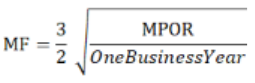
- (b) for transactions included in the netting sets referred to in Article 275(2) and (3), the maturity factor is defined as:
-
- where:
- MF = the maturity factor;
- MPOR = the margin period of risk of the netting set determined in accordance with Article 285(2) to (5); and
- When determining the margin period of risk for transactions between a client and a clearing member, an institution acting either as the client or as the clearing member shall replace the minimum period set out in point (b) of Article 285(2) with five business days.

2.
For the purposes of paragraph 1, the remaining maturity shall be equal to the period of time until the next reset date for transactions that are structured to settle outstanding exposure following specified payment dates and where the terms are reset in such a way that the market value of the contract shall be zero on those specified payment dates.
- 01/01/2022
- Legal Instruments that change this rule 2.
Export Article as
Article 280 Hedging Set Supervisory Factor Coefficient
For the purpose of calculating the add-on of a hedging set as referred to in Articles 280a to 280f, the hedging set supervisory factor coefficient ‘ε’ shall be the following:
ε = 1 for the hedging sets established in accordance with Article 277a(1)
5 for the hedging sets established in accordance with point (a) of Article 277a(2)
0.5 for the hedging sets established in accordance with point (b) of Article 277a(2)
Article 280a Interest Rate Risk Category Add-On
1.
For the purposes of Article 278, institutions shall calculate the interest rate risk category add-on for a given netting set as follows:
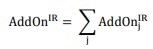
where:
AddOnIR = the interest rate risk category add-on;
j = the index that denotes all the interest risk rate hedging sets established in accordance with point (a) of Article 277a(1) and with Article 277a(2) for the netting set; and

2.
Institutions shall calculate the interest rate risk category add-on for hedging set j as follows:

where:
εj = the hedging set supervisory factor coefficient of hedging set j determined in accordance with the applicable value specified in Article 280;
SFIR = the supervisory factor for the interest rate risk category with a value equal to 0.5%; and
EffNotIR = the effective notional amount of hedging set j calculated in accordance with paragraph 3.
- 01/01/2022
- Legal Instruments that change this rule 2.
3.
For the purpose of calculating the effective notional amount of hedging set j, institutions shall first map each transaction of the hedging set to the appropriate bucket in Table 2. They shall do so on the basis of the end date of each transaction as determined under point (a) of Article 279b(1):
Table 2
| Bucket | End date (in years) |
| 1 | > 0 and <= 1 |
| 2 | > 1 and <= 5 |
| 3 | > 5 |
Institutions shall then calculate the effective notional amount of hedging set j in accordance with the following formula:

where:

Dj,k = the effective notional amount of bucket k of hedging set j calculated as follows:
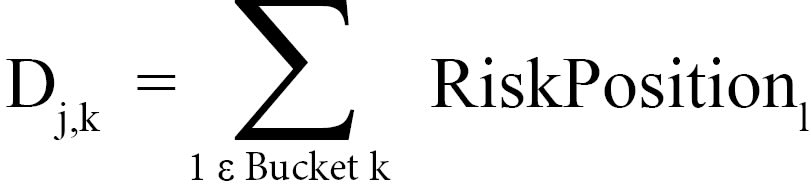
where:
l = the index that denotes the risk position.
- 01/01/2022
- Legal Instruments that change this rule 3.
Article 280b Foreign Exchange Risk Category Add-On
1.
For the purposes of Article 278, institutions shall calculate the foreign exchange risk category add-on for a given netting set as follows:
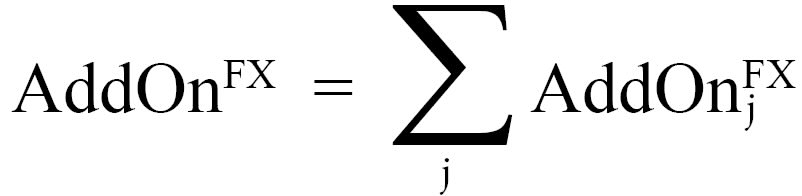
where:
AddOnFX = the foreign exchange risk category add on;
J = the index that denotes the foreign exchange risk hedging sets established in accordance with point (b) of Article 277a(1) and with Article 277a(2) for the netting set; and

2.
Institutions shall calculate the foreign exchange risk category add-on for hedging set j as follows:

where:
εj the hedging set supervisory factor coefficient of hedging set j determined in accordance with Article 280;
SFFX the supervisory factor for the foreign exchange risk category with a value equal to 4%;


where:
l = the index that denotes the risk position
- 01/01/2022
- Legal Instruments that change this rule 2.
Article 280c Credit Risk Category Add-On
1.
For the purposes of paragraph 2, institutions shall establish the relevant credit reference entities of the netting set in accordance with the following:
- (a) there shall be one credit reference entity for each issuer of a reference debt instrument that underlies a single-name transaction allocated to the credit risk category; single-name transactions shall be assigned to the same credit reference entity only where the underlying reference debt instrument of those transactions is issued by the same issuer;
- (b) there shall be one credit reference entity for each group of reference debt instruments or single-name credit derivatives that underlie a multi-name transaction allocated to the credit risk category; multi-names transactions shall be assigned to the same credit reference entity only where the group of underlying reference debt instruments or single-name credit derivatives of those transactions have the same constituents.
2.
For the purposes of Article 278, institutions shall calculate the credit risk category add-on for a given netting set as follows:

where:

j = the index that denotes all the credit risk hedging sets established in accordance with point (c) of Article 277a(1) and with Article 277a(2) for the netting set; and

3.
Institutions shall calculate the credit risk category add-on for hedging set j as follows:

where:
εj = the hedging set supervisory factor coefficient of hedging set j determined in accordance with Article 280;
k = the index that denotes the credit reference entities of the netting set established in accordance with paragraph 1;

AddOn(Entityk) = the add-on for the credit reference entity k determined in accordance with paragraph 4.
4.
Institutions shall calculate the add-on for the credit reference entity k as follows:

where:
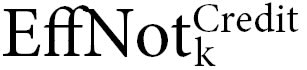

where:
l = the index that denotes the risk position; and

- 01/01/2022
- Legal Instruments that change this rule 4.
5.
Institutions shall calculate the supervisory factor applicable to the credit reference entity k as follows:
- (a) for the credit reference entity k established in accordance with point (a) of paragraph 1,
- (i) an institution using the approach referred to in the Credit Risk: Internal Ratings Based Approach (CRR) Part shall map the internal rating of the individual issuer to one of the external credit assessments;
- (ii) an institution using the approach referred to in the Credit Risk: Standardised Approach (CRR) Part and Chapter 2 of Title II of Part Three of CRR shall assign
- (b) for the credit reference entity k established in accordance with point (b) of paragraph 1:
- (i) where a risk position l assigned to the credit reference entity k is a credit index listed on a recognised exchange,
- (ii) where a risk position l assigned to the credit reference entity k is not referred to in point (i) of this point,
Table 3
| Credit quality step | Supervisory factor for single-name transactions |
| 1 | 0.38% |
| 2 | 0.42% |
| 3 | 0.54% |
| 4 | 1.06% |
| 5 | 1.6% |
| 6 | 6.0% |
Table 4
| Dominant credit quality | Supervisory factor for quoted indices |
| Investment grade | 0.38% |
| Non-investment grade | 1.06% |
Article 280d Equity Risk Category Add-On
1.
For the purposes of paragraph 2, institutions shall establish the relevant equity reference entities of the netting set in accordance with the following:
- (a) there shall be one equity reference entity for each issuer of a reference equity instrument that underlies a single-name transaction allocated to the equity risk category; single-name transactions shall be assigned to the same equity reference entity only where the underlying reference equity instrument of those transactions is issued by the same issuer;
- (b) there shall be one equity reference entity for each group of reference equity instruments or single-name equity derivatives that underlie a multi-name transaction allocated to the equity risk category; multi-names transactions shall be assigned to the same equity reference entity only where the group of underlying reference equity instruments or single-name equity derivatives of those transactions, as applicable, has the same constituents.
2.
For the purposes of Article 278, institutions shall calculate the equity risk category add-on for a given netting set as follows:

where:
AddOnEquity = the equity risk category add-on;
j = the index that denotes all the equity risk hedging sets established in accordance with point (d) of Article 277a(1) and Article 277a(2) for the netting set; and

3.
Institutions shall calculate the equity risk category add-on for hedging set j as follows:

where:
εj = the hedging set supervisory factor coefficient of hedging set j determined in accordance with Article 280;
k = the index that denotes the equity reference entities of the netting set established in accordance with paragraph 1;

AddOn(Entityk) = the add-on for the equity reference entity k determined in accordance with paragraph 4.
4.
Institutions shall calculate the add-on for the equity reference entity k as follows:

where:
AddOn(Entityk) = the add-on for the equity reference entity k;



where:
l = the index that denotes the risk position.
- 01/01/2022
- Legal Instruments that change this rule 4.
Article 280e Commodity Risk Category Add-On
1.
For the purposes of Article 278, institutions shall calculate the commodity risk category add-on for a given netting set as follows:

where:
AddOnCom = the commodity risk category add-on;
j = the index that denotes the commodity hedging sets established in accordance with point (e) of Article 277a(1) and with Article 277a(2) for the netting set; and

2.
For the purpose of calculating the add-on for a commodity hedging set of a given netting set in accordance with paragraph 4, institutions shall establish the relevant commodity reference types of each hedging set. Commodity derivative transactions shall be assigned to the same commodity reference type only where the underlying commodity instrument of those transactions has the same nature, irrespective of the delivery location and quality of the commodity instrument.
3.
[Note: Provision left blank]
- 01/01/2022
- Legal Instruments that change this rule 3.
4.
Institutions shall calculate the commodity risk category add-on for hedging set j as follows:

where:

εj = the hedging set supervisory factor coefficient of hedging set j determined in accordance with Article 280;

k = the index that denotes the commodity reference types of the netting set established in accordance with paragraph 2; and

5.
Institutions shall calculate the add-on for the commodity reference type k as follows:

where:
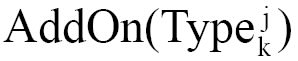



where:
l = the index that denotes the risk position.
- 01/01/2022
- Legal Instruments that change this rule 5.
Article 280f Other Risks Category Add-On
1.
For the purposes of Article 278, institutions shall calculate the other risks category add-on for a given netting set as follows:

where:
AddOnOther = the other risks category add-on;
j = the index that denotes the other risk hedging sets established in accordance with point (f) of Article 277a(1) and Article 277a(2) for the netting set; and

2.
Institutions shall calculate the other risks category add-on for hedging set j as follows:

where:
εj = the hedging set supervisory factor coefficient of hedging set j determined in accordance with Article 280;
SFOther= the supervisory factor for the other risk category with a value equal to 8%; and
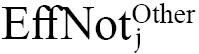

where:
l = the index that denotes the risk position.
- 01/01/2022
- Legal Instruments that change this rule 2.
Section 4 Simplified Standardised Approach for Counterparty Credit Risk
Article 281 Calculation of the Exposure Value
1.
Institutions shall calculate a single exposure value at netting set level in accordance with Section 3, subject to paragraph 2 of this Article.
2.
The exposure value of a netting set shall be calculated in accordance with the following requirements:
- (a) institutions shall not apply the treatment referred to in Article 274(6);
- (b) by way of derogation from Article 275(1), for netting sets that are not referred to in Article 275(2), institutions shall calculate the replacement cost in accordance with the following formula:
- RC = max{CMV, 0}
- where:
- RC = the replacement cost; and
- CMV = the current market value.
- (c) by way of derogation from Article 275(2), for netting sets of transactions: that are traded on a recognised exchange; that are centrally cleared by a central counterparty authorised in accordance with Article 14 of Regulation (EU) No 648/2012 or recognised in accordance with Article 25 of that Regulation; or for which collateral is exchanged bilaterally with the counterparty in accordance with Article 11 of Regulation (EU) No 648/2012, institutions shall calculate the replacement cost in accordance with the following formula:
- RC = TH + MTA
- where:
- RC = the replacement cost;
- TH = the margin threshold applicable to the netting set under the margin agreement below which the institution cannot call for collateral; and
- MTA = the minimum transfer amount applicable to the netting set under the margin agreement;
- (d) by way of derogation from Article 275(3), for multiple netting sets that are subject to a margin agreement, institutions shall calculate the replacement cost as the sum of the replacement cost of each individual netting set, calculated in accordance with paragraph 1 as if they were not margined;
- (e) all hedging sets shall be established in accordance with Article 277a(1);
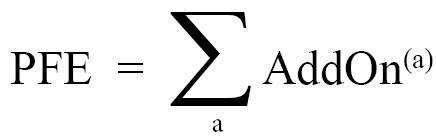
- (f) institutions shall set to 1 the multiplier in the formula that is used to calculate the potential future exposure in Article 278(1), as follows:
-
- where:
- PFE = the potential future exposure; and
- AddOn(a) = the add-on for risk category a;
- (g) by way of derogation from Article 279a(1), for all transactions, institutions shall calculate the supervisory delta as follows:
- δ =
- where:
- δ = the supervisory delta;
- (h) the formula referred to in point (a) of Article 279b(1) that is used to compute the supervisory duration factor shall read as follows:
- supervisory duration factor = E – S
- where:
- E = the period between the end date of a transaction and the calculation date; and
- S = the period between the start date of a transaction and the calculation date;
- (i) the maturity factor referred to in Article 279c(1) shall be calculated as follows:
- (i) for transactions included in netting sets referred to in Article 275(1), MF = 1;
- (ii) for transactions included in netting sets referred to in Article 275(2) and (3), MF = 0.42;
- (j) the formula referred to in Article 280a(3) that is used to calculate the effective notional amount of hedging set j shall read as follows:
-
- where:
-
= the effective notional amount of hedging set j; and
- Dj,k = the effective notional amount of bucket k of hedging set j;
- (k) the formula referred to in Article 280c(3) that is used to calculate the credit risk category add-on for hedging set j shall read as follows:
-
- where:
-
= the credit risk category add-on for hedging set j; and
- AddOn(Entityk) = the add-on for the credit reference entity k;
- (l) the formula referred to in Article 280d(3) that is used to calculate the equity risk category add-on for hedging set j shall read as follows:
-
- where:
-
= the equity risk category add-on for hedging set j; and
- AddOn(Entityk) = the add-on for the credit reference entity k;
- (m) the formula referred to in Article 280e(4) that is used to calculate the commodity risk category add-on for hedging set j of the commodity risk category in Article 280e(3) shall read as follows:
-
- where:
-
= the commodity risk category add-on for hedging set j; and
-
= the add-on for the commodity reference type k.





Section 5 Original Exposure Method
Article 282 Calculation of the Exposure Value
1.
Institutions may calculate a single exposure value for all the transactions within a contractual netting agreement where all the conditions set out in Article 274(1) are met. Otherwise, institutions shall calculate an exposure value separately for each transaction, which shall be treated as its own netting set.
2.
The exposure value of a netting set or a transaction shall be the product of 1.4 times the sum of the current replacement cost and the potential future exposure.
3.
The current replacement cost referred to in paragraph 2 shall be calculated as follows:
- (a) for netting sets of transactions: that are traded on a recognised exchange; centrally cleared by a central counterparty authorised in accordance with Article 14 of Regulation (EU) No 648/2012 or recognised in accordance with Article 25 of that Regulation; or for which collateral is exchanged bilaterally with the counterparty in accordance with Article 11 of Regulation (EU) No 648/2012, institutions shall use the following formula:
- RC = TH + MTA
- where:
- RC = the replacement cost;
- TH = the margin threshold applicable to the netting set under the margin agreement below which the institution cannot call for collateral; and
- MTA = the minimum transfer amount applicable to the netting set under the margin agreement;
- (b) for all other netting sets or individual transactions, institutions shall use the following formula:
- RC = max{CMV, 0}
- where:
- RC = the replacement cost; and
- CMV = the current market value.
In order to calculate the current replacement cost, institutions shall update current market values at least monthly.
4.
Institutions shall calculate the potential future exposure referred to in paragraph 2 as follows:
- (a) the potential future exposure of a netting set is the sum of the potential future exposure of all the transactions included in the netting set, calculated in accordance with point (b);
- (b) the potential future exposure of a single transaction is its notional amount multiplied by:
- (i) the product of 0.5% and the residual maturity of the transaction expressed in years for interest-rate derivative contracts;
- (ii) the product of 6% and the residual maturity of the transaction expressed in years for credit derivative contracts;
- (iii) 4% for foreign-exchange derivatives;
- (iv) 18% for gold and commodity derivatives other than electricity derivatives;
- (v) 40% for electricity derivatives;
- (vi) 32% for equity derivatives;
- (c) the notional amount referred to in point (b) of this paragraph shall be determined in accordance with Article 279b(2) and (3) for all derivatives listed in that point; in addition, the notional amount of the derivatives referred to in points (b)(iii) to (b)(vi) of this paragraph shall be determined in accordance with points (b) and (c) of Article 279b(1);
- (d) the potential future exposure of netting sets referred to in point (a) of paragraph 3 shall be multiplied by 0.42.
For calculating the potential exposure of interest-rate derivatives and credit derivatives in accordance with points b(i) and (b)(ii), an institution may choose to use the original maturity instead of the residual maturity of the contracts.
Section 6 Internal Model Method
Article 283 Permission to use the Internal Model Method
1.
An institution, that is not an SDDT or SDDT consolidation entity, that has a 138BA permission from the PRA to disapply the methods set out in Sections 3 to 5 of this Chapter (if otherwise applicable) and to apply the method set out in Section 6 of this Chapter shall use the Internal Model Method (IMM) to calculate the exposure value for any of the following transactions:
- (a) transactions in Article 273(2)(a);
- (b) transactions in Article 273(2)(b), (c) and (d);
- (c) transactions in Article 273(2)(a) to (d),
- to the extent and subject to any modifications set out in the 138BA permission.
Where an institution has a 138BA permission from the PRA to disapply the methods set out in Sections 3 to 5 of this Chapter (if otherwise applicable) and uses the IMM to calculate exposure value for any of the transactions mentioned in points (a) to (c) of the first paragraph, it may also be granted a 138BA permission to use the IMM for the transactions in Article 273(2)(e), and in this case shall calculate the exposure value for those transactions using the IMM.
Notwithstanding the third subparagraph of Article 273(1), an institution may choose not to apply this method to exposures that are immaterial in size and risk. In such case, an institution shall apply one of the methods set out in Sections 3 to 5 of this Chapter to these exposures where the relevant requirements for each approach are met.
- 01/01/2027
- Legal Instruments that change this rule 1.
2.
[Note: Provision left blank]
- 01/01/2027
- Legal Instruments that change this rule 2.
3.
Institutions that have been granted a 138BA permission to use the IMM which provides for implementation of the IMM sequentially across different transaction types shall use the methods set out in Sections 3 to 5 of this Chapter (if otherwise applicable) for transaction types for which they do not use the IMM during the period of sequential implementation, as specified in the 138BA permission.
- 01/01/2027
- Legal Instruments that change this rule 3.
4.
For all OTC derivative transactions, and for long settlement transactions (where the exposure value of long settlement transactions is determined in accordance with this Chapter) for which an institution has not received a 138BA permission to disapply the methods set out in Sections 3 to 5 of this Chapter (if otherwise applicable) and use the IMM, the institution shall use the method set out in Section 3 of this Chapter. Those methods may be used in combination on a permanent basis within a group.
- 01/01/2027
- Legal Instruments that change this rule 4.
5.
An institution that has a 138BA permission to disapply the methods set out in Sections 3 to 5 of this Chapter (if otherwise applicable) and uses the IMM shall not revert to the use of the methods set out in Sections 3 to 5 of this Chapter (if otherwise applicable) unless it has a 138BA permission from the PRA to do so.
- 01/01/2027
- Legal Instruments that change this rule 5.
6.
If an institution ceases to comply with the requirements laid down in this Section (Section 6 of this Chapter), it shall notify the PRA and do one of the following:
- (a) present to the PRA a plan for a timely return to compliance;
- (b) demonstrate to the PRA that the effect of non-compliance is immaterial.
[Note: This rule corresponds to Article 283 of the CRR as it applied immediately before its revocation by the Treasury except there is no corresponding rule for Article 283(2) of the CRR]
- 01/01/2027
- Legal Instruments that change this rule 6.
Article 284 Exposure Value
1.
Where an institution has a 138BA permission to use the IMM to calculate the exposure value of some or all transactions mentioned in Article 283(1), it shall measure the exposure value of those transactions at the level of the netting set.
The model used by the institution for that purpose shall:
- (a) specify the forecasting distribution for changes in the market value of the netting set attributable to joint changes in relevant market variables, such as interest rates, foreign exchange rates; and
- (b) calculate the exposure value for the netting set at each of the future dates on the basis of the joint changes in the market variables.
- 01/01/2027
- Legal Instruments that change this rule 1.
2.
In order for the model to capture the effects of margining, the model of the collateral value shall meet the quantitative, qualitative and data requirements for the IMM in accordance with this Section and the institution may include in its forecasting distributions for changes in the market value of the netting set only eligible financial collateral as referred to in the Credit Risk Mitigation (CRR) Part Articles 197 and 198, and point (d) of Article 299(2) and Article 299A of this Part.
- 01/01/2027
- Legal Instruments that change this rule 2.
3.
The own funds requirement for counterparty credit risk with respect to the CCR exposures to which an institution applies the IMM, shall be the higher of the following:
- (a) the own funds requirement for those exposures calculated on the basis of Effective EPE using current market data;
- (b) the own funds requirement for those exposures calculated on the basis of Effective EPE using a single consistent stress calibration for all CCR exposures to which they apply the IMM.
- 01/01/2027
- Legal Instruments that change this rule 3.
4.
Except for counterparties identified as having Specific Wrong-way Risk that fall within the scope of Article 291(4) and (5), institutions shall calculate the exposure value as the product of alpha (α) times Effective EPE, as follows:
\[Exposure\ value\ =\ \alpha\ \cdot Effective \ EPE\]
where:
α = 1.4, unless otherwise specified in the institution’s 138BA permission
Effective EPE shall be calculated by estimating expected exposure as the average exposure at future date t, where the average is taken across possible future values of relevant market risk factors.
The model shall estimate EE at a series of future dates t1, t2, t3, etc.
- 01/01/2027
- Legal Instruments that change this rule 4.
5.
Institutions shall calculate Effective EE recursively as:
\[Effective\ {EE}_{tk}=\max{\left\{Effective\ {EE}_{tk-1},{\ EE}_{tk}\right\}}\]
where:
the current date is denoted as t0;
Effective EEt0 equals current exposure.
- 01/01/2027
- Legal Instruments that change this rule 5.
6.
Effective EPE is the average Effective EE during the first year of future exposure. If all contracts in the netting set mature within less than one year, EPE shall be the average of EE until all contracts in the netting set mature. Institutions shall calculate Effective EPE as a weighted average of Effective EE:
\[Effective\ EPE=\frac{1}{min{\left\{1\ year,\ maturity\right\}}}\ \times\ \sum\nolimits_{k=1}^{min{\left\{1\ year,\ maturity\right\}}}{Effective\ EE}_{tk}\times ∆tk\]
where the weights Δtk= tk – tk - 1 allow for the case when future exposure is calculated at dates that are not equally spaced over time.
- 01/01/2027
- Legal Instruments that change this rule 6.
7.
Institutions shall calculate EE or peak exposure measures on the basis of a distribution of exposures that accounts for the possible non-normality of the distribution of exposures.
- 01/01/2027
- Legal Instruments that change this rule 7.
8.
An institution may use a measure of the distribution calculated by the IMM that is more conservative than α multiplied by Effective EPE as calculated in accordance with the equation in paragraph 4 for every counterparty.
- 01/01/2027
- Legal Instruments that change this rule 8.
9.
Notwithstanding paragraph 4, an institution may use their own estimates of alpha if the PRA has granted a 138BA permission to do so. For an institution that has been granted this 138BA permission:
- (a) alpha shall equal the ratio of internal capital from a full simulation of CCR exposure across counterparties (numerator) and internal capital based on EPE (denominator);
- (b) in the denominator, EPE shall be used as if it were a fixed outstanding amount.
When estimated in accordance with this paragraph, alpha shall be no lower than 1.2.
- 01/01/2027
- Legal Instruments that change this rule 9.
10.
For the purposes of an estimate of alpha under paragraph 9 where an institution has been granted a 138BA permission to use own estimates of alpha, an institution shall ensure that the numerator and denominator are calculated in a manner consistent with the modelling methodology, parameter specifications and portfolio composition. The approach used to estimate alpha shall be based on the institution’s internal capital approach, be well documented and be subject to independent validation. In addition, an institution shall review its estimates of alpha on at least a quarterly basis, and more frequently when the composition of the portfolio varies over time. An institution shall also assess the model risk.
- 01/01/2027
- Legal Instruments that change this rule 10.
11.
An institution that has been granted a 138BA permission to use own estimates of alpha, shall ensure that its internal estimates of alpha capture in the numerator material sources of dependency of distribution of market values of transactions or of portfolios of transactions across counterparties. Internal estimates of alpha shall take account of the granularity of portfolios.
- 01/01/2027
- Legal Instruments that change this rule 11.
12.
In establishing the estimates in paragraph 9, institutions shall have regard to the significant variation in estimates of alpha that arises from the potential for mis-specification in the models used for the numerator, especially where convexity is present.
- 01/01/2027
- Legal Instruments that change this rule 12.
13.
Institutions shall where appropriate, condition volatilities and correlations of market risk factors used in the joint modelling of market and credit risk on the credit risk factor to reflect potential increases in volatility or correlation in an economic downturn.
[Note: This rule corresponds to Article 284 of the CRR as it applied immediately before its revocation by the Treasury]
- 01/01/2027
- Legal Instruments that change this rule 13.
Export Article as
Article 285 Exposure Value for Netting Sets Subject to a Margin Agreement
1.
If the netting set is subject to a margin agreement and daily mark-to-market valuation, the institution shall calculate Effective EPE as set out in this paragraph. An institution shall use one of the following Effective EPE measures:
- (a) Effective EPE, calculated without taking into account any collateral held or posted by way of margin plus any collateral that has been posted to the counterparty independent of the daily valuation and margining process or current exposure;
- (b) Effective EPE, calculated as the potential increase in exposure over the margin period of risk, plus the larger of:
- (i) the current exposure including all collateral currently held or posted, other than collateral called or in dispute;
- (ii) the largest net exposure, including collateral under the margin agreement, that would not trigger a collateral call. This amount shall reflect all applicable thresholds, minimum transfer amounts, independent amounts and initial margins under the margin agreement.
An institution which has a model which captures the effects of margining may, with the 138BA permission of the PRA, use the model’s EE measure directly in the equation in Article 284(5) instead.
For the purposes of point (b), institutions shall calculate the add-on as the expected positive change of the mark-to-market value of the transactions during the margin period of risk. Changes in the value of collateral shall be reflected using Financial Collateral Comprehensive Method in accordance with the Credit Risk Mitigation (CRR) Part, but no collateral payments shall be assumed during the margin period of risk. The margin period of risk is subject to the minimum periods set out in paragraphs 2 to 5.
- 01/01/2027
- Legal Instruments that change this rule 1.
2.
For transactions subject to daily re-margining and mark-to-market valuation, institutions shall use a margin period of risk for the purpose of modelling the exposure value with margin agreements of not less than:
- (a) five business days for netting sets consisting only of repurchase transactions, securities or commodities lending or borrowing transactions and margin lending transactions;
- (b) 10 business days for all other netting sets.
- 01/01/2027
- Legal Instruments that change this rule 2.
3.
Points (a) and (b) of paragraph 2 shall be subject to the following exceptions:
- (a) for all netting sets where the number of trades exceeds 5000 at any point during a quarter, the margin period of risk for the following quarter shall not be less than 20 business days. This exception shall not apply to institutions’ trade exposures;
- (b) for netting sets containing one or more trades involving either illiquid collateral, or an OTC derivative that cannot be easily replaced, the margin period of risk shall not be less than 20 business days.
An institution shall determine whether collateral is illiquid or whether OTC derivatives cannot be easily replaced in the context of stressed market conditions, which shall be characterised by the absence of continuously active markets where a counterparty would, within two days or fewer, obtain multiple price quotations that would not move the market or represent a price reflecting a market discount (in the case of collateral) or premium (in the case of an OTC derivative).
An institution shall consider whether trades or securities it holds as collateral are concentrated in a particular counterparty and if that counterparty exited the market precipitously whether the institution would be able to replace those trades or securities.
- 01/01/2027
- Legal Instruments that change this rule 3.
4.
If an institution has been involved in more than two margin call disputes on a particular netting set over the immediately preceding two quarters that have lasted longer than the applicable margin period of risk under paragraphs 2 and 3, the institution shall use a margin period of risk that is at least double the period specified in paragraphs 2 and 3 for that netting set for the subsequent two quarters.
- 01/01/2027
- Legal Instruments that change this rule 4.
5.
For re-margining with a periodicity of N days, the margin period of risk shall be at least equal to the period specified in paragraphs 2 and 3, F, plus N days minus one day. That is:
Margin Period of Risk = F + N – 1
- 01/01/2027
- Legal Instruments that change this rule 5.
6.
If the internal model includes the effect of margining on changes in the market value of the netting set, an institution shall model collateral, other than cash of the same currency as the exposure itself, jointly with the exposure in its exposure value calculations for OTC derivatives and securities financing transactions.
- 01/01/2027
- Legal Instruments that change this rule 6.
7.
If an institution is not able to model collateral jointly with the exposure, it shall not recognise in its exposure value calculations for OTC derivatives and securities financing transactions the effect of collateral other than cash of the same currency as the exposure itself, unless it uses Financial Collateral Comprehensive Method in accordance with the Credit Risk Mitigation (CRR) Part.
- 01/01/2027
- Legal Instruments that change this rule 7.
8.
An institution using the IMM shall ignore in its models the effect of a reduction of the exposure value due to any clause in a collateral agreement that requires receipt of collateral when counterparty credit quality deteriorates.
[Note: This rule corresponds to Article 285 of the CRR as it applied immediately before its revocation by the Treasury]
- 01/01/2027
- Legal Instruments that change this rule 8.
Article 286 Management of CCR – Policies, Processes and Systems
1.
An institution shall establish and maintain a CCR management framework, consisting of:
- (a) policies, processes and systems to ensure the identification, measurement, management, approval and internal reporting of CCR;
- (b) procedures for ensuring that those policies, processes and systems are complied with.
Those policies, processes and systems shall be conceptually sound, implemented with integrity and documented. The documentation shall include an explanation of the empirical techniques used to measure CCR.
- 01/01/2027
- Legal Instruments that change this rule 1.
2.
The CCR management framework required by paragraph 1 shall take account of market, liquidity, and legal and operational risks that are associated with CCR. In particular, the framework shall ensure that the institution complies with the following principles:
- (a) it does not undertake business with a counterparty without assessing its creditworthiness;
- (b) it takes due account of settlement and pre-settlement credit risk;
- (c) it manages such risks as comprehensively as practicable at the counterparty level by aggregating CCR exposures with other credit exposures and at the firm-wide level.
- 01/01/2027
- Legal Instruments that change this rule 2.
3.
An institution using the IMM shall ensure that its CCR management framework accounts for the liquidity risks of all of the following:
- (a) potential incoming margin calls in the context of exchanges of variation margin or other margin types, such as initial or independent margin, under adverse market shocks;
- (b) potential incoming calls for the return of excess collateral posted by counterparties;
- (c) calls resulting from a potential downgrade of its own external credit quality assessment.
An institution shall ensure that the nature and horizon of collateral re-use is consistent with its liquidity needs and does not jeopardise its ability to post or return collateral in a timely manner.
- 01/01/2027
- Legal Instruments that change this rule 3.
4.
An institution’s management body and senior management shall be actively involved in, and ensure that adequate resources are allocated to, the management of CCR. Senior management shall be aware of the limitations and assumptions of the model used and the impact those limitations and assumptions can have on the reliability of the output through a formal process. Senior management shall be also aware of the uncertainties of the market environment and operational issues and of how these are reflected in the model.
- 01/01/2027
- Legal Instruments that change this rule 4.
5.
The daily reports prepared on an institution’s exposures to CCR in accordance with Article 287(2)(b) shall be reviewed by a level of management with sufficient seniority and authority to enforce both reductions of positions taken by individual credit managers or traders and reductions in the institution’s overall CCR exposure.
- 01/01/2027
- Legal Instruments that change this rule 5.
6.
An institution’s CCR management framework established in accordance with paragraph 1 shall be used in conjunction with internal credit and trading limits. Credit and trading limits shall be related to the institution’s risk measurement model in a manner that is consistent over time and that is well understood by credit managers, traders and senior management. An institution shall have a formal process to report breaches of risk limits to the appropriate level of management.
- 01/01/2027
- Legal Instruments that change this rule 6.
7.
An institution’s measurement of CCR shall include measuring daily and intra-day use of credit lines. The institution shall measure current exposure gross and net of collateral. At portfolio and counterparty level, the institution shall calculate and monitor peak exposure or potential future exposure at the confidence interval chosen by the institution. The institution shall take account of large or concentrated positions, including by groups of related counterparties, by industry and by market.
- 01/01/2027
- Legal Instruments that change this rule 7.
8.
An institution shall establish and maintain a routine and rigorous program of stress testing. The results of that stress testing shall be reviewed regularly and at least quarterly by senior management and shall be reflected in the CCR policies and limits set by the management body or senior management. Where stress tests reveal particular vulnerability to a given set of circumstances, the institution shall take prompt steps to manage those risks.
[Note: This rule corresponds to Article 286 of the CRR as it applied immediately before its revocation by the Treasury]
- 01/01/2027
- Legal Instruments that change this rule 8.
Article 287 Organisation Structures for CCR Management
1.
- 01/01/2027
- Legal Instruments that change this rule 1.
2.
The risk control unit shall be responsible for the design and implementation of its CCR management, including the initial and on-going validation of the model, and shall carry out the following functions and meet the following requirements:
- (a) it shall be responsible for the design and implementation of the CCR management system of the institution;
- (b) it shall produce daily reports on and analyse the output of the institution’s risk measurement model. That analysis shall include an evaluation of the relationship between measures of CCR exposure values and trading limits;
- (c) it shall control input data integrity and produce and analyse reports on the output of the institution’s risk measurement model, including an evaluation of the relationship between measures of risk exposure and credit and trading limits;
- (d) it shall be independent from units responsible for originating, renewing or trading exposures and free from undue influence;
- (e) it shall be adequately staffed;
- (f) it shall report directly to the senior management of the institution;
- (g) its work shall be closely integrated into the day-to-day credit risk management process of the institution;
- (h) its output shall be an integral part of the process of planning, monitoring and controlling the institution’s credit and overall risk profile.
- 01/01/2027
- Legal Instruments that change this rule 2.
3.
The collateral management unit shall carry out the following tasks and functions:
- (a) calculating and making margin calls, managing margin call disputes and reporting levels of independent amounts, initial margins and variation margins accurately on a daily basis;
- (b) controlling the integrity of the data used to make margin calls, and ensuring that it is consistent and reconciled regularly with all relevant sources of data within the institution;
- (c) tracking the extent of re-use of collateral and any amendment of the rights of the institution to or in connection with the collateral that it posts;
- (d) reporting to the appropriate level of management the types of collateral assets that are reused, and the terms of such reuse including instrument, credit quality and maturity;
- (e) tracking concentration to individual types of collateral assets accepted by the institution;
- (f) reporting collateral management information on a regular basis, but at least quarterly, to senior management, including information on the type of collateral received and posted, the size, aging and cause for margin call disputes. That internal reporting shall also reflect trends in these figures.
- 01/01/2027
- Legal Instruments that change this rule 3.
4.
Senior management shall allocate sufficient resources to the collateral management unit required under paragraph 1(b) to ensure that its systems achieve an appropriate level of operational performance, as measured by the timeliness and accuracy of margin calls by the institution and the timeliness of the response of the institution to margin calls by its counterparties. Senior management shall ensure that the unit is adequately staffed to process calls and disputes in a timely manner even under severe market crisis, and to enable the institution to limit its number of large disputes caused by trade volumes.
[Note: This rule corresponds to Article 287 of the CRR as it applied immediately before its revocation by the Treasury]
- 01/01/2027
- Legal Instruments that change this rule 4.
Article 288 Review of CCR Management System
An institution shall regularly conduct an independent review of its CCR management system through its internal auditing process. That review shall include both the activities of the control and collateral management units required by Article 287 and shall specifically address, as a minimum:
- (a) the adequacy of the documentation of the CCR management system and process required by Article 286;
- (b) the organisation of the CCR control unit required by Article 287(1)(a);
- (c) the organisation of the collateral management unit required by Article 287(1)(b);
- (d) the integration of CCR measures into daily risk management;
- (e) the approval process for risk pricing models and valuation systems used by front and back-office personnel;
- (f) the validation of any significant change in the CCR measurement process;
- (g) the scope of CCR captured by the risk measurement model;
- (h) the integrity of the management information system;
- (i) the accuracy and completeness of CCR data;
- (j) the accurate reflection of legal terms in collateral and netting agreements into exposure value measurements;
- (k) the verification of the consistency, timeliness and reliability of data sources used to run models, including the independence of such data sources;
- (l) the accuracy and appropriateness of volatility and correlation assumptions;
- (m) the accuracy of valuation and risk transformation calculations;
- (n) the verification of the model’s accuracy through frequent back-testing as set out in points (b) to (e) of Article 293(1);
- (o) the compliance of the CCR control unit and collateral management unit with the relevant regulatory requirements.
[Note: This rule corresponds to Article 288 of the CRR as it applied immediately before its revocation by the Treasury]
Article 289 Use Test
1.
Institutions shall ensure that the distribution of exposures generated by the model used to calculate Effective EPE is closely integrated into the day-to-day CCR management process of the institution, and that the output of the model is taken into account in the process of credit approval, CCR management, internal capital allocation and corporate governance.
- 01/01/2027
- Legal Instruments that change this rule 1.
2.
[Note: Provision left blank]
- 01/01/2027
- Legal Instruments that change this rule 2.
3.
- 01/01/2027
- Legal Instruments that change this rule 3.
4.
In addition to EPE, an institution shall measure and manage current exposures. Where appropriate, the institution shall measure current exposures gross and net of collateral. The use test is satisfied if an institution uses other CCR measures, such as peak exposure, based on the distribution of exposures generated by the same model to compute EPE.
- 01/01/2027
- Legal Instruments that change this rule 4.
5.
An institution shall have the systems capability to estimate EE daily if necessary to calculate its exposures to CCR, unless the institution’s 138BA permission to use IMM provides for less frequent calculation in accordance with the terms of the 138BA permission. The institution shall estimate EE along a time profile of forecasting horizons that adequately reflects the time structure of future cash flows and maturity of the contracts and in a manner that is consistent with the materiality and composition of the exposures.
- 01/01/2027
- Legal Instruments that change this rule 5.
6.
An institution shall measure, monitor and control exposure over the life of all contracts in the netting set and not only to the one-year horizon. The institution shall have procedures in place to identify and control the risks for counterparties where the exposure rises beyond the one-year horizon. The forecast increase in exposure shall be an input into the institution’s internal capital model.
[Note: This rule corresponds to Article 289 of the CRR as it applied immediately before its revocation by the Treasury except there is no corresponding rule for Article 289(2) of the CRR]
- 01/01/2027
- Legal Instruments that change this rule 6.
Article 290 Stress Testing
1.
- 01/01/2027
- Legal Instruments that change this rule 1.
2.
It shall identify possible events or future changes in economic conditions that could have unfavourable effects on an institution’s credit exposures and assess the institution’s ability to withstand such changes.
- 01/01/2027
- Legal Instruments that change this rule 2.
3.
The stress measures under the programme shall be compared against risk limits and considered by the institution as part of the Internal Capital Adequacy Assessment Part 6.1.
- 01/01/2027
- Legal Instruments that change this rule 3.
4.
The programme shall comprehensively capture trades and aggregate exposures across all forms of counterparty credit risk at the level of specific counterparties in a sufficient time frame to conduct regular stress testing.
- 01/01/2027
- Legal Instruments that change this rule 4.
5.
It shall provide for at least monthly exposure stress testing of principal market risk factors such as interest rates, FX, equities, credit spreads, and commodity prices for all counterparties of the institution, in order to identify, and enable the institution when necessary to reduce outsized concentrations in specific directional risks. Exposure stress testing - including single factor, multifactor and material non-directional risks - and joint stressing of exposure and creditworthiness shall be performed at the counterparty-specific, counterparty group and aggregate institution-wide CCR levels.
- 01/01/2027
- Legal Instruments that change this rule 5.
6.
It shall apply at least quarterly multifactor stress testing scenarios and assess material non-directional risks including yield curve exposure and basis risks. Multiple-factor stress tests shall, at a minimum, address the following scenarios in which the following occurs:
- (a) severe economic or market events have occurred;
- (b) broad market liquidity has decreased significantly;
- (c) a large financial intermediary is liquidating positions.
- 01/01/2027
- Legal Instruments that change this rule 6.
7.
The severity of the shocks of the underlying risk factors shall be consistent with the purpose of the stress test. When evaluating solvency under stress, the shocks of the underlying risk factors shall be sufficiently severe to capture historical extreme market environments and extreme but plausible stressed market conditions. The stress tests shall evaluate the impact of such shocks on own funds, own funds requirements and earnings. For the purpose of day-to-day portfolio monitoring, hedging, and management of concentrations the testing programme shall also consider scenarios of lesser severity and higher probability.
- 01/01/2027
- Legal Instruments that change this rule 7.
8.
The programme shall include provision, where appropriate, for reverse stress tests to identify extreme, but plausible, scenarios that could result in significant adverse outcomes. Reverse stress testing shall account for the impact of material non-linearity in the portfolio.
- 01/01/2027
- Legal Instruments that change this rule 8.
9.
The results of the stress testing under the programme shall be reported regularly, at least on a quarterly basis, to senior management. The reports and analysis of the results shall cover the largest counterparty-level impacts across the portfolio, material concentrations within segments of the portfolio (within the same industry or region), and relevant portfolio and counterparty specific trends.
- 01/01/2027
- Legal Instruments that change this rule 9.
10.
Senior management shall take a lead role in the integration of stress testing into the risk management framework and risk culture of the institution and ensure that the results are meaningful and used to manage CCR. The results of stress testing for significant exposures shall be assessed against guidelines that indicate the institution’s risk appetite, and referred to senior management for discussion and action when excessive or concentrated risks are identified.
[Note: This rule corresponds to Article 290 of the CRR as it applied immediately before its revocation by the Treasury]
- 01/01/2027
- Legal Instruments that change this rule 10.
Export Article as
Article 291 Wrong-way Risk
1.
For the purposes of this Article:
- (a) ‘General Wrong-way Risk’ arises when the likelihood of default by counterparties is positively correlated with general market risk factors;
- (b) ‘Specific Wrong-way Risk’ arises when future exposure to a specific counterparty is positively correlated with the counterparty’s PD due to the nature of the transactions with the counterparty. An institution shall be considered to be exposed to Specific Wrong-way Risk if the future exposure to a specific counterparty is expected to be high when the counterparty’s probability of a default is also high.
- 01/01/2027
- Legal Instruments that change this rule 1.
2.
An institution shall give due consideration to exposures that give rise to a significant degree of Specific and General Wrong-way Risk.
- 01/01/2027
- Legal Instruments that change this rule 2.
3.
In order to identify General Wrong-way Risk, an institution shall design stress testing and scenario analyses to stress risk factors that are adversely related to counterparty creditworthiness. Such testing shall address the possibility of severe shocks occurring when relationships between risk factors have changed. An institution shall monitor General Wrong-way Risk by product, by region, by industry, or by other categories that are relevant to the business.
- 01/01/2027
- Legal Instruments that change this rule 3.
4
An institution shall maintain procedures to identify, monitor and control cases of Specific Wrong-way Risk for each legal entity, beginning at the inception of a transaction and continuing through the life of the transaction.
- 01/01/2027
- Legal Instruments that change this rule 4
5.
Institutions shall calculate the own funds requirements for CCR in relation to transactions where Specific Wrong-way Risk has been identified and where there exists a legal connection between the counterparty and the issuer of the underlying of the OTC derivative or the underlying of the transactions referred to in points (b), (c) and (d) of Article 273(2), in accordance with the following principles:
- (a) the instruments where Specific Wrong-way Risk exists shall not be included in the same netting set as other transactions with the counterparty, and shall each be treated as a separate netting set;
- (b) within any such separate netting set, for single-name credit default swaps the exposure value equals the full expected loss in the value of the remaining fair value of the underlying instruments based on the assumption that the underlying issuer is in liquidation;
- (c) LGD for an institution using the approach set out in the Credit Risk: Internal Ratings Based Approach (CRR) Part shall be 100% for such swap transactions;
- (d) for an institution using the approach set out in the Credit Risk: Standardised Approach (CRR) Part and Chapter 2 of Title II of Part Three of CRR, the applicable risk weight shall be that of an unsecured transaction;
- (e) for all other transactions referencing a single name in any such separate netting set, the calculation of the exposure value shall be consistent with the assumption of a jump-to-default of those underlying obligations where the issuer is legally connected with the counterparty. For transactions referencing a basket of names or index, the jump-to-default of the respective underlying obligations where the issuer is legally connected with the counterparty shall be applied, if material;
- (f) to the extent that this uses existing market risk calculations for own funds requirements for default risk as set out in either the Market Risk: Internal Model Approach (CRR) Part or the Market Risk: Advanced Standardised Approach (CRR) Part that already contain an LGD assumption, the LGD in the formula used shall be 100%.
- 01/01/2027
- Legal Instruments that change this rule 5.
6.
Institutions shall provide senior management and the appropriate committee of the management body with regular reports on both Specific and General Wrong-way Risks and the steps being taken to manage those risks.
[Note: This rule corresponds to Article 291 of the CRR as it applied immediately before its revocation by the Treasury]
- 01/01/2027
- Legal Instruments that change this rule 6.
Export Article as
Article 292 Integrity of the Modelling Process
1.
An institution shall ensure the integrity of modelling process as set out in Article 284 by adopting at least the following measures:
- (a) the model shall reflect transaction terms and specifications in a timely, complete, and conservative fashion;
- (b) those terms shall include at least contract notional amounts, maturity, reference assets, margining arrangements and netting arrangements;
- (c) those terms and specifications shall be maintained in a database that is subject to formal and periodic audit;
- (d) a process for recognising netting arrangements that requires legal staff to verify that netting under those arrangements is legally enforceable;
- (e) the verification required under point (d) shall be entered into the database mentioned in point (c) by an independent unit;
- (f) the transmission of transaction terms and specification data to the EPE model shall be subject to internal audit;
- (g) there shall be processes for formal reconciliation between the model and source data systems to verify on an ongoing basis that transaction terms and specifications are being reflected in EPE correctly or at least conservatively.
- 01/01/2027
- Legal Instruments that change this rule 1.
2.
Current market data shall be used to determine current exposures. An institution may calibrate its EPE model using either historical market data or market implied data to establish parameters of the underlying stochastic processes, such as drift, volatility and correlation. If an institution uses historical data, it shall use at least three years of such data. The data shall be updated at least quarterly, and more frequently if necessary to reflect market conditions.
To calculate the Effective EPE using a stress calibration, an institution shall calibrate Effective EPE using either three years of data that includes a period of stress to the credit default spreads of its counterparties or market implied data from such a period of stress.
The requirements in paragraphs 3, 4 and 5 shall be applied by the institution for that purpose.
- 01/01/2027
- Legal Instruments that change this rule 2.
3.
An institution shall verify, at least quarterly, that the stress period used for the calculation under this paragraph coincides with a period of increased credit default swap or other credit (such as loan or corporate bond) spreads for a representative selection of its counterparties with traded credit spreads, and shall be able to produce such verification to the PRA on request. In situations where the institution does not have adequate credit spread data for a counterparty, it shall map that counterparty to specific credit spread data based on region, internal rating and business types.
- 01/01/2027
- Legal Instruments that change this rule 3.
4.
- 01/01/2027
- Legal Instruments that change this rule 4.
5.
To evaluate the effectiveness of its stress calibration for Effective EPE, an institution shall create several benchmark portfolios that are vulnerable to the main risk factors to which the institution is exposed. The exposure to these benchmark portfolios shall be calculated using (a) a stress methodology, based on current market values and model parameters calibrated to stressed market conditions, and (b) the exposure generated during the stress period, but applying the method set out in this Section (end of stress period market value, volatilities, and correlations from the three-year stress period).
An institution must adjust the stress calibration if the exposures of those benchmark portfolios deviate substantially from each other.
- 01/01/2027
- Legal Instruments that change this rule 5.
6.
An institution shall subject the model to a validation process that is clearly articulated in the institutions’ policies and procedures. That validation process shall:
- (a) specify the kind of testing needed to ensure model integrity and identify conditions under which the assumptions underlying the model are inappropriate and may therefore result in an understatement of EPE;
- (b) include a review of the comprehensiveness of the model.
- 01/01/2027
- Legal Instruments that change this rule 6.
7.
An institution shall monitor the relevant risks and have processes in place to adjust its estimation of Effective EPE when those risks become significant. In complying with this paragraph, the institution shall:
- (a) identify and manage its exposures to Specific Wrong-Way risk arising as specified in Article 291(1)(b) and exposures to General Wrong-Way risk arising as specified in Article 291(1)(a);
- (b) for exposures with a rising risk profile after one year, compare on a regular basis the estimate of a relevant measure of exposure over one year with the same exposure measure over the life of the exposure;
- (c) for exposures with a residual maturity below one year, compare on a regular basis the replacement cost (current exposure) and the realised exposure profile, and store data that would allow such a comparison.
- 01/01/2027
- Legal Instruments that change this rule 7.
8.
An institution shall have internal procedures to verify that, prior to including a transaction in a netting set, the transaction is covered by a legally enforceable netting contract that meets the requirements set out in Section 7 of Chapter 3.
- 01/01/2027
- Legal Instruments that change this rule 8.
9.
An institution that uses collateral to mitigate its CCR shall have internal procedures to verify that, prior to recognising the effect of collateral in its calculations, the collateral meets the legal certainty standards set out in the Credit Risk Mitigation (CRR) Part.
[Note: This rule corresponds to Article 292 of the CRR as it applied immediately before its revocation by the Treasury]
- 01/01/2027
- Legal Instruments that change this rule 9.
Article 293 Requirements for the Risk Management System
1.
An institution shall comply with the following requirements:
- (a) it shall meet the qualitative requirements set out in the Market Risk: Internal Model Approach (CRR) Part;
- (b) it shall conduct a regular programme of back-testing, comparing the risk measures generated by the model with realised risk measures, and hypothetical changes based on static positions with realised measures;
- (c) it shall carry out an initial validation and an on-going periodic review of its CCR exposure model and the risk measures generated by it. The validation and review shall be independent of the model development;
- (d) the management body and senior management shall be involved in the risk control process and shall ensure that adequate resources are devoted to credit and counterparty credit risk control. In this regard, the daily reports prepared by the independent risk control unit established in accordance Article 287(1)(a) shall be reviewed by a level of management with sufficient seniority and authority to enforce both reductions of positions taken by individual traders and reductions in the overall risk exposure of the institution;
- (e) the internal risk measurement exposure model shall be integrated into the day-to-day risk management process of the institution;
- (f) the risk measurement system shall be used in conjunction with internal trading and exposure limits. In this regard, exposure limits shall be related to the institution’s risk measurement model in a manner that is consistent over time and that is well understood by traders, the credit function and senior management;
- (g) an institution shall ensure that its risk management system is well documented. In particular, it shall maintain a documented set of internal policies, controls and procedures concerning the operation of the risk measurement system, and arrangements to ensure that those policies are complied with;
- (h) an independent review of the risk measurement system shall be carried out regularly in the institution’s own internal auditing process. This review shall include both the activities of the business trading units and of the independent risk control unit. A review of the overall risk management process shall take place at regular intervals (and no less than once a year) and shall specifically address, as a minimum, all items referred to in Article 288;
- (i) the on-going validation of counterparty credit risk models, including back-testing, shall be reviewed periodically by a level of management with sufficient authority to decide the action that will be taken to address weaknesses in the models.
- 01/01/2027
- Legal Instruments that change this rule 1.
2.
[Note: Provision left blank]
- 01/01/2027
- Legal Instruments that change this rule 2.
3.
An institution shall document the process for initial and on-going validation of its CCR exposure model and the calculation of the risk measures generated by the models to a level of detail that would enable a third party to recreate, respectively, the analysis and the risk measures. That documentation shall set out the frequency with which back-testing analysis and any other on-going validation will be conducted, how the validation is conducted with respect to data flows and portfolios and the analyses that are used.
- 01/01/2027
- Legal Instruments that change this rule 3.
4.
An institution shall define criteria with which to assess its CCR exposure models and the models that input into the calculation of exposure and maintain a written policy that describes the process by which unacceptable performance will be identified and remedied.
- 01/01/2027
- Legal Instruments that change this rule 4.
5.
An institution shall define how representative counterparty portfolios are constructed for the purposes of validating an CCR exposure model and its risk measures.
- 01/01/2027
- Legal Instruments that change this rule 5.
6.
The validation of CCR exposure models and their risk measures that produce forecast distributions shall consider more than a single statistic of the forecast distribution.
[Note: This rule corresponds to Article 293 of the CRR as it applied immediately before its revocation by the Treasury except there is no corresponding rule for Article 293(2) of the CRR]
- 01/01/2027
- Legal Instruments that change this rule 6.
Article 294 Validation Requirements
1.
As part of the on-going validation of its CCR exposure model and its risk measures, an institution shall ensure that the following requirements are met:
- (a) [Note: Provision left blank]
- (b) the institution using the approach set out in Article 285(1)(b) shall regularly validate its model to test whether realised current exposures are consistent with prediction over all margin periods within one year. If some of the trades in the netting set have a maturity of less than one year, and the netting set has higher risk factor sensitivities without these trades, the validation shall take this into account;
- (c) it shall back-test the performance of its CCR exposure model and the model’s relevant risk measures as well as the market risk factor predictions. For collateralised trades, the prediction time horizons considered shall include those reflecting typical margin periods of risk applied in collateralised or margined trading;
- (d) if the model validation indicates that Effective EPE is underestimated, the institution shall take the action necessary to address the inaccuracy of the model;
- (e) it shall test the pricing models used to calculate CCR exposure for a given scenario of future shocks to market risk factors as part of the initial and on-going model validation process. Pricing models for options shall account for the nonlinearity of option value with respect to market risk factors;
- (f) the CCR exposure model shall capture the transaction-specific information necessary to be able to aggregate exposures at the level of the netting set. An institution shall verify that transactions are assigned to the appropriate netting set within the model;
- (g) the CCR exposure model shall include transaction-specific information to capture the effects of margining. It shall take into account both the current amount of margin and margin that would be passed between counterparties in the future. Such a model shall account for the nature of margin agreements that are unilateral or bilateral, the frequency of margin calls, the margin period of risk, the minimum threshold of un-margined exposure the institution is willing to accept, and the minimum transfer amount. Such a model shall either estimate the mark-to-market change in the value of collateral posted or apply the rules set out in the Credit Risk Mitigation (CRR) Part;
- (h) the model validation process shall include static, historical back-testing on representative counterparty portfolios. An institution shall conduct such back-testing on a number of representative counterparty portfolios that are actual or hypothetical at regular intervals. Those representative portfolios shall be chosen on the basis of their sensitivity to the material risk factors and combinations of risk factors to which the institution is exposed;
- (i) an institution shall conduct back-testing that is designed to test the key assumptions of the CCR exposure model and the relevant risk measures, including the modelled relationship between tenors of the same risk factor, and the modelled relationships between risk factors;
- (j) the performance of CCR exposure models and its risk measures shall be subject to appropriate back-testing practice. The back-testing programme shall be capable of identifying poor performance in an EPE model’s risk measures;
- (k) an institution shall validate its CCR exposure models and all risk measures out to time horizons commensurate with the maturity of trades for which exposure is calculated using IMM in accordance to the Article 283;
- (l) an institution shall regularly test the pricing models used to calculate counterparty exposure against appropriate independent benchmarks as part of the on-going model validation process;
- (m) the on-going validation of an institution’s CCR exposure model and the relevant risk measures shall include an assessment of the adequacy of the recent performance;
- (n) the frequency with which the parameters of an CCR exposure model are updated shall be assessed by an institution as part of the initial and on-going validation process;
- (o) the initial and on-going validation of CCR exposure models shall assess whether or not the counterparty level and netting set exposure calculations of exposure are appropriate.
- 01/01/2027
- Legal Instruments that change this rule 1.
2.
An institution may use a measure that is more conservative than the metric used to calculate regulatory exposure value for every counterparty in place of alpha multiplied by Effective EPE, if the PRA has granted a 138BA permission to use IMM. The degree of relative conservatism will be assessed at the regular supervisory reviews of the EPE models. An institution that has been granted a 138BA permission shall validate the conservatism regularly, and on-going assessment of model performance shall cover all counterparties for which the models are used.
- 01/01/2027
- Legal Instruments that change this rule 2.
3.
- 01/01/2027
- Legal Instruments that change this rule 3.
Section 7 Contractual Netting
Article 295 Recognition of Contractual Netting as Risk-reducing
Institutions may treat as risk reducing in accordance with Article 298 only the following types of contractual netting agreements where the institution meets the requirements set out in paragraphs 2 and 3 of Article 296 and Article 297:
- (a) bilateral contracts for novation between an institution and its counterparty under which mutual claims and obligations are automatically amalgamated in such a way that the novation fixes one single net amount each time it applies so as to create a single new contract that replaces all former contracts and all obligations between parties pursuant to those contracts and is binding on the parties;
- (b) other bilateral agreements between an institution and its counterparty;
- (c) contractual cross product netting agreements for institutions that have received a 138BA permission to disapply the methods set out in Sections 3 to 5 of this Chapter (if otherwise applicable) and use the method set out in Section 6 of Chapter 3 for transactions falling under the scope of that method.
Netting across transactions entered into by different legal entities of a group shall not be recognised for the purposes of calculating the own funds requirements.
[Note: This rule corresponds to Article 295 of the CRR as it applied immediately before its revocation by the Treasury]
Article 296 Recognition of Contractual Netting Agreements
1.
[Note: Provision left blank]
- 01/01/2027
- Legal Instruments that change this rule 1.
2.
An institution shall not use a contractual netting agreement for determining exposure values in this Part, unless it meets the following requirements:
- (a) the institution has concluded a contractual netting agreement with its counterparty which creates a single legal obligation, covering all included transactions, such that, in the event of default by the counterparty it would be entitled to receive or obliged to pay only the net sum of the positive and negative mark-to-market values of included individual transactions;
- (b) the institution has written and reasoned legal opinions to the effect that, in the event of a legal challenge of the netting agreement, the institution’s claims and obligations would not exceed those referred to in point (a), and the institution must be able to make available these legal opinions upon request by the PRA. The legal opinion shall refer to the applicable law of:
- (i) the jurisdiction in which the counterparty is incorporated;
- (ii) if a branch of an undertaking is involved, which is located in a country other than that where the undertaking is incorporated, the jurisdiction in which the branch is located;
- (iii) the jurisdiction whose law governs the individual transactions included in the netting agreement;
- (iv) the jurisdiction whose law governs any contract or agreement necessary to effect the contractual netting;
- (c) credit risk to each counterparty is aggregated to arrive at a single legal exposure across transactions with each counterparty. This aggregation shall be factored into credit limit purposes and internal capital purposes;
- (d) the contract shall not contain any clause which, in the event of default of a counterparty, permits a non-defaulting counterparty to make limited payments only, or no payments at all, to the estate of the defaulting party, even if the defaulting party is a net creditor (i.e. walk-away clause).
If an institution is unable to obtain sufficiently robust and reasoned legal opinions establishing that contractual netting is legally valid and enforceable under the law of each of the jurisdictions referred to in point (b) the contractual netting agreement shall not be recognised as risk-reducing for either of the counterparties.
- 01/01/2027
- Legal Instruments that change this rule 2.
3.
The legal opinions referred to in point (b) may be drawn up by reference to types of contractual netting. The following additional conditions shall be fulfilled by contractual cross product netting agreements:
- (a) the net sum referred to in point (a) of paragraph 2 is the net sum of the positive and negative close out values of any included individual bilateral master agreement and of the positive and negative mark-to-market value of the individual transactions (the ‘cross-product net amount’);
- (b) the legal opinions referred to in point (b) of paragraph 2 shall address the validity and enforceability of the entire contractual cross product netting agreements under its terms and the impact of the netting arrangement on the material provisions of any included individual bilateral master agreement.
[Note: This rule corresponds to Article 296 of the CRR as it applied immediately before its revocation by the Treasury except there is no corresponding rule for Article 296(1) of the CRR]
- 01/01/2027
- Legal Instruments that change this rule 3.
Article 297 Obligations of Institutions
1.
An institution shall establish and maintain procedures to ensure that the legal validity and enforceability of its contractual netting is reviewed in the light of changes in the law of relevant jurisdictions referred to in Article 296(2)(b).
- 01/01/2027
- Legal Instruments that change this rule 1.
2.
The institution shall maintain all required documentation relating to its contractual netting in its files.
- 01/01/2027
- Legal Instruments that change this rule 2.
3.
The institution shall factor the effects of netting into its measurement of each counterparty’s aggregate credit risk exposure and the institution shall manage its CCR on the basis of those effects of that measurement.
- 01/01/2027
- Legal Instruments that change this rule 3.
4.
In the case of contractual cross product netting agreements referred to in Article 295, the institution shall maintain procedures under Article 296(2)(c) to verify that any transaction which is to be included in a netting set is covered by a legal opinion referred to in Article 296(2)(b).
Taking into account the contractual cross product netting agreement, the institution shall continue to comply with the requirements for the recognition of bilateral netting and the requirements of the Credit Risk Mitigation (CRR) Part for the recognition of credit risk mitigation, as applicable, with respect to each included individual bilateral master agreement and transaction.
[Note: This rule corresponds to Article 297 of the CRR as it applied immediately before its revocation by the Treasury]
- 01/01/2027
- Legal Instruments that change this rule 4.
Article 298 Effects of Recognition of Netting as Risk-reducing
Netting for the purposes of Sections 3 to 6 of this Chapter shall be recognised as set out in those Sections.
[Note: This rule corresponds to Article 298 of the CRR as it applied immediately before its revocation by the Treasury]
Section 8 Items in the Trading Book
Article 299 Items in the Trading Book
1.
For the purposes of the application of this Article, Annex 1 of Chapter 3 of this Part shall include a reference to derivative instruments for the transfer of credit risk as mentioned in paragraph 8 of Part 1 of Schedule 2 to the Regulated Activities Order.
- 01/01/2027
- Legal Instruments that change this rule 1.
2.
When calculating risk-weighted exposure amounts for counterparty risk of items in the trading book, institutions shall comply with the following principles:
- (a) [Note: Provision left blank]
- (b) institutions shall not use the Financial Collateral Simple Method set out in Article 222 for the recognition of the effects of financial collateral;
- (c) [Note: Provision left blank]
- (d) for exposures arising from OTC derivative instruments booked in the trading book, institutions may recognise commodities that are eligible to be included in the trading book as eligible collateral provided that the requirements in paragraphs (a) to (c) of Article 299A are met;
- (e) for the purposes of calculating volatility adjustments where financial instruments or commodities which are not eligible under the Credit Risk Mitigation (CRR) Part are lent, sold or provided, or borrowed, purchased or received by way of collateral or otherwise under such a transaction, and an institution is using the Financial Collateral Comprehensive Method in accordance with the Credit Risk Mitigation (CRR) Part, institutions shall treat such instruments and commodities in the same way as non-main index equities listed on a recognised exchange;
- (f) where an institution has permission to use the SFT VaR Method defined in the Credit Risk Mitigation (CRR) Part 1.2, it may also apply that approach in the trading book;
- (g) in relation to the recognition of master netting agreements covering repurchase transactions, securities or commodities lending or borrowing transactions, or other capital market-driven transactions, institutions shall only recognise netting across positions in the trading book and the non-trading book when the netted transactions fulfil the following conditions:
- (i) all transactions are marked to market daily;
- (ii) any items borrowed, purchased or received under the transactions may be recognised as eligible financial collateral under the Credit Risk Mitigation (CRR) Part without the application of points (d) to (f) of this paragraph;
- (h) where a credit derivative included in the trading book forms part of an internal hedge and the credit protection is recognised in accordance with the Credit Risk Mitigation (CRR) Part Article 204, institutions shall apply one of the following approaches:
- (i) treat it as if there were no counterparty risk arising from the position in that credit derivative;
- (ii) consistently include for the purpose of calculating the own funds requirements for counterparty credit risk all credit derivatives in the trading book forming part of internal hedges or purchased as protection against a CCR exposure where the credit protection is recognised as eligible under the Credit Risk Mitigation (CRR) Part.
[Note: This rule corresponds to Article 299 (except for Article 299(2)(c)) of the CRR as it applied immediately before its revocation by the Treasury]
- 01/01/2027
- Legal Instruments that change this rule 2.
Article 299A Repurchase Transactions and Securities or Commodities Lending or Borrowing Transactions – Eligible Collateral
1.
When calculating risk-weighted exposure amounts for counterparty risk of repurchase transactions and securities or commodities lending or borrowing transactions booked in the trading book, an institution may recognise as eligible collateral any financial instruments and commodities that are eligible to be included in the trading book; provided that such institution shall:
- (a) have assessed the market liquidity, including under stressed conditions, of such financial instruments and commodities received as collateral and ensure that it is able to demonstrate at all times sufficient depth within the market to exit the position in a timely manner;
- (b) ensure that it has the legal and operational capabilities to trade such financial instruments and commodities in the relevant markets; and
- (c) ensure that it has the capability to risk manage and value such financial instruments and commodities consistent with the trading book requirements set out in the Trading Book (CRR) Part Articles 103 and 105 as if such financial instruments and commodities were included in the trading book.
- 01/01/2027
- Legal Instruments that change this rule 1.
Section 9 Own Funds Requirements for Exposures to a Central Counterparty
Article 301 Material Scope
1.
This Section applies to the following contracts and transactions, for as long as they are outstanding with a CCP:
- (a) the derivative contracts listed in Annex 1 of this Part and credit derivatives;
- (b) securities financing transactions and fully guaranteed deposit lending or borrowing transactions; and
- (c) long settlement transactions.
This Section does not apply to exposures arising from the settlement of cash transactions. Institutions shall apply the treatment laid down in Title V to trade exposures arising from those transactions and a 0% risk weight to default fund contributions covering only those transactions. Institutions shall apply the treatment set out in Article 307 to default fund contributions that cover any of the contracts listed in the first subparagraph of this paragraph in addition to cash transactions.
2.
For the purposes of this Section, the following requirements shall apply:
- (a) the initial margin shall not include contributions to a CCP for mutualised loss sharing arrangements;
- (b) the initial margin shall include collateral deposited by an institution acting as a clearing member or by a client in excess of the minimum amount required respectively by the CCP or by the institution acting as a clearing member, provided the CCP or the institution acting as a clearing member may, in appropriate cases, prevent the institution acting as a clearing member or the client from withdrawing such excess collateral;
- (c) where a CCP uses the initial margin to mutualise losses among its clearing memberss, institutions that act as clearing members shall treat that initial margin as a default fund contribution.
[Note: This rule corresponds to Article 301 of the CRR as it applied immediately before revocation by the Treasury.]
- 01/01/2022
- Legal Instruments that change this rule 2.
Export Article as
Article 302 Monitoring of Exposures to CCPs
1.
Institutions shall monitor all their exposures to CCPs and shall lay down procedures for the regular reporting of information on those exposures to senior management and appropriate committee or committees of the management body.
- 01/01/2022
- Legal Instruments that change this rule 1.
2.
Institutions shall assess, through appropriate scenario analysis and stress testing, whether the level of own funds held against exposures to a CCP, including potential future or contingent credit exposures, exposures from default fund contributions and, where the institution is acting as a clearing member, exposures resulting from contractual arrangements as laid down in Article 304, adequately relates to the inherent risks of those exposures.
[Note: This rule corresponds to Article 302 of the CRR as it applied immediately before revocation by the Treasury.]
- 01/01/2022
- Legal Instruments that change this rule 2.
Article 303 Treatment of Clearing Members' Exposures to CCPs
1.
An institution that acts as a clearing member, either for its own purposes or as a financial intermediary between a client and a CCP, shall calculate the own funds requirements for its exposures to a CCP as follows:
- (a) it shall apply the treatment set out in Article 306 to its trade exposures with the CCP;
- (b) it shall apply the treatment set out in Article 307 to its default fund contributions to the CCP.
- 01/01/2022
- Legal Instruments that change this rule 1.
2.
For the purposes of paragraph 1, the sum of an institution's own funds requirements for its exposures to a QCCP due to trade exposures and default fund contributions shall be subject to a cap equal to the sum of own funds requirements that would be applied to those same exposures if the CCP were a non-qualifying CCP.
[Note: This rule corresponds to Article 303 of the CRR as it applied immediately before revocation by the Treasury.]
- 01/01/2022
- Legal Instruments that change this rule 2.
Article 304 Treatment of Clearing Members' Exposures to Clients
1.
An institution that acts as a clearing member and, in that capacity, acts as a financial intermediary between a client and a CCP shall calculate the own funds requirements for its CCP-related transactions with that client:
- (a) in accordance with Sections 1 to 8 of this Chapter and the Credit Risk Mitigation (CRR) Part and the Credit Valuation Adjustment Risk Part, as applicable, if the institution is not an SDDT or an SDDT consolidation entity; or
- (b) in accordance with Sections 1 to 5 and Sections 7 to 8 of this Chapter and the Credit Risk Mitigation (CRR) Part and the Credit Valuation Adjustment Risk Part, as applicable, if the institution is an SDDT or an SDDT consolidation entity.
2.
Where an institution acting as a clearing member enters into a contractual arrangement with a clientt of another clearing member that facilitates, in accordance with Article 48(5) and (6), of Regulation (EU) No 648/2012, the transfer of positions and collateral referred to in Article 305(2)(b) for that client, and that contractual agreement gives rise to a contingent obligation for that institution, that institution may attribute an exposure value of zero to that contingent obligation.
- 01/01/2022
- Legal Instruments that change this rule 2.
3.
Where an institution that acts as a clearing member uses the methods set out in Section 3 or 6 of this Chapter to calculate the own funds requirement for its exposures, the following provisions shall apply:
- (a) by way of derogation from Article 285(2), the institution may use a margin period of risk of at least five business days for its exposures to a client;
- (b) the institution shall apply a margin period of risk of at least 10 business days for its exposures to a CCP;
- (c) by way of derogation from Article 285(3), where a netting set included in the calculation meets the condition set out in point (a) of that paragraph, the institution may disregard the limit set out in that point, provided that the netting set does not meet the condition set out in point (b) of that paragraph and does not contain disputed trades or exotic options;
- (d) where a CCP retains variation margin against a transaction, and the institution's collateral is not protected against the insolvency of the CCP, the institution shall apply a margin period of risk that is the lower of one year and the remaining maturity of the transaction, with a floor of 10 business days.
4.
By way of derogation from point (i) of Article 281(2), where an institution that acts as a clearing member uses the method set out in Section 4 to calculate the own funds requirement for its exposures to a client, the institution may use a maturity factor of 0.21 for its calculation.
- 01/01/2022
- Legal Instruments that change this rule 4.
5.
By way of derogation from point (d) of Article 282(4), where an institution that acts as a clearing member uses the method set out in Section 5 to calculate the own funds requirement for its exposures to a client, that institution may use a maturity factor of 0.21 in that calculation.
- 01/01/2022
- Legal Instruments that change this rule 5.
6.
An institution that acts as a clearing member may use the reduced exposure at default resulting from the calculations set out in paragraphs 3, 4 and 5 for the purposes of calculating its own funds requirements for CVA risk in accordance with Title VI.
- 01/01/2022
- Legal Instruments that change this rule 6.
7.
An institution that acts as a clearing member that collects collateral from a client for a CCP-related transaction and passes the collateral on to the CCP may recognise that collateral to reduce its exposure to the client for that CCP-related transaction.
In the case of a multi-level client structure, the treatment set out in the first subparagraph may be applied at each level of that structure.
[Note: This rule corresponds to Article 304 of the CRR as it applied immediately before revocation by the Treasury.]
- 01/01/2022
- Legal Instruments that change this rule 7.
Article 305 Treatment of Clients' Exposures
1.
An institution that is a client shall calculate the own funds requirements for its CCP-related transactions with its clearing member:
- (a) in accordance with Sections 1 to 8 of this Chapter, the Credit Risk Mitigation (CRR) Part and the Credit Valuation Adjustment Risk Part, as applicable, if the institution is not an SDDT or an SDDT consolidation entity; or
- (b) in accordance with Sections 1 to 5 and Sections 7 to 8 of this Chapter, the Credit Risk Mitigation (CRR) Part and the Credit Valuation Adjustment Risk Part, as applicable, if the institution is an SDDT or an SDDT consolidation entity.
2.
Without prejudice to the approach specified in paragraph 1, where an institution is a client, it may calculate the own funds requirements for its trade exposures for CCP-related transactions with its clearing member in accordance with Article 306 provided that all the following conditions are met:
- (a) the positions and assets of that institution related to those transactions are distinguished and segregated, at the level of both the clearing member and the CCP, from the positions and assets of both the clearing member and the other clients of that clearing member and as a result of that distinction and segregation those positions and assets are bankruptcy remote in the event of the default or insolvency of the clearing member or one or more of its other clients;
- (b) laws, regulations, rules and contractual arrangements applicable to or binding that institution or the CCP facilitate the transfer of the client's positions relating to those contracts and transactions and of the corresponding collateral to another clearing member within the applicable margin period of risk in the event of default or insolvency of the original clearing member. In such circumstance, the client's positions and the collateral shall be transferred at market value unless the client requests to close out the position at market value;
- (c) the client has conducted a sufficiently thorough legal review, which it has kept up to date, that substantiates that the arrangements that ensure that the condition set out in point (b) is met are legal, valid, binding and enforceable under the relevant laws of the relevant jurisdiction or jurisdictions;
- (d) the CCP is a QCCP.
When assessing its compliance with the condition set out in point (b) of the first subparagraph, an institution may take into account any clear precedents of transfers of client positions and of corresponding collateral at a CCP, and any industry intent to continue with that practice.
3.
By way of derogation from paragraph 2 of this Article, where an institution that is a clientt fails to meet the condition set out in point (a) of that paragraph because that institution is not protected from losses in case the clearing member and another client of the clearing member jointly default, provided that all the other conditions set out in points (a) to (d) of that paragraph are met, the institution may calculate the own funds requirements for its trade exposures for CCP-related transactions with its clearing member in accordance with Article 306, subject to replacing the 2% risk weight set out in point (a) of Article 306(1) with a 4% risk weight.
- 01/01/2022
- Legal Instruments that change this rule 3.
4.
In the case of a multi-level client structure, an institution that is a lower-level client accessing the services of a CCP through a higher-level client, may apply the treatment set out in paragraph 2 or 3 only where the conditions in each paragraph are met at every level of that structure.
[Note: This rule corresponds to Article 305 of the CRR as it applied immediately before revocation by the Treasury.]
- 01/01/2022
- Legal Instruments that change this rule 4.
Article 306 Own Funds Requirements for Trade Exposures
1.
An institution shall apply the following treatment to its trade exposures with CCPs:
- (a) it shall apply a risk weight of 2% to the exposure values of all its trade exposures with QCCPs;
- (b) it shall apply the risk weight used for the Standardised Approach to credit risk as set out in Article 107(2)(b) to all its trade exposures with non-qualifying CCPs;
- (c) where an institution acts as a financial intermediary between a client and a CCP, and the terms of the CCP-related transaction stipulate that the institution is not required to reimburse the client for any losses suffered due to changes in the value of that transaction in the event that the CCP defaults, that institution may set the exposure value of the trade exposure with the CCP that corresponds to that CCP-related transaction to zero;
- (d) where an institution acts as a financial intermediary between a client and a CCP, and the terms of the CCP-related transaction stipulate that the institution is required to reimburse the client for any losses suffered due to changes in the value of that transaction in the event that the CCP defaults, that institution shall apply the treatment in point (a) or (b), as applicable, to the trade exposure with the CCP that corresponds to that CCP-related transaction.
- 01/01/2022
- Legal Instruments that change this rule 1.
2.
By way of derogation from paragraph 1, where assets posted as collateral to a CCP or a clearing member are bankruptcy remote in the event that the CCP, the clearing member or one or more of the other clients of the clearing member becomes insolvent, an institution may attribute an exposure value of zero to the counterparty credit risk exposures for those assets.
3.
An institution that is not an SDDT or an SDDT consolidation entity shall calculate exposure values of its trade exposures with a CCP in accordance with Sections 1 to 8 of this Chapter and with the Credit Risk Mitigation (CRR) Part, as applicable.
An institution that is an SDDT or an SDDT consolidation entity shall calculate exposure values of its trade exposures with a CCP in accordance with Sections 1 to 5 and Sections 7 to 8 of this Chapter and with the Credit Risk Mitigation (CRR) Part, as applicable.
4.
An institution shall calculate the risk-weighted exposure amounts for its trade exposures with CCPs for the purposes of paragraph 3 of Required Level of Own Funds (CRR) Part Article 92 as the sum of the exposure values of its trade exposures with CCPs, calculated in accordance with paragraphs 2 and 3, multiplied by the risk weight determined in accordance with paragraph 1.
[Note: This rule corresponds to Article 306 of the CRR as it applied immediately before revocation by the Treasury]
Article 307 Own Funds Requirements for Contributions to the Default Fund of a CCP
An institution that acts as a clearing member shall apply the following treatment to its exposures arising from its contributions to the default fund of a CCP:
- (a) it shall calculate the own funds requirement for its pre-funded contributions to the default fund of a QCCP in accordance with the approach set out in Article 308;
- (b) it shall calculate the own funds requirement for its pre-funded and unfunded contributions to the default fund of a non-qualifying CCP in accordance with the approach set out in Article 309;
- (c) it shall calculate the own funds requirement for its unfunded contributions to the default fund of a QCCP in accordance with the treatment set out in Article 310.
[Note: This rule corresponds to Article 307 of the CRR as it applied immediately before revocation by the Treasury.]
Article 308 Own Funds Requirements for Pre-Funded Contributions to the Default Fund of a QCCP
1.
The exposure value for an institution's pre-funded contribution to the default fund of a QCCP (DFi) shall be the amount paid in or the market value of the assets delivered by that institution reduced by any amount of that contribution that the QCCP has already used to absorb its losses following the default of one or more of its clearing members.
- 01/01/2022
- Legal Instruments that change this rule 1.
2.
An institution shall calculate the own funds requirement to cover the exposure arising from its pre-funded contribution as follows:

where:
Ki = the own funds requirement;
i = the index denoting the clearing member;
KCCP = the hypothetical capital of the QCCP communicated to the institution by the QCCP in accordance with Article 50c of Regulation (EU) No 648/2012;
DFi = the pre-funded contribution;
DFCCP = the pre-funded financial resources of the CCP communicated to the institution by the CCP in accordance with Article 50c of Regulation (EU) No 648/2012; and
DFCM = the sum of pre-funded contributions of all clearing members of the QCCP communicated to the institution by the QCCP in accordance with Article 50c of Regulation (EU) No 648/2012.
- 01/01/2022
- Legal Instruments that change this rule 2.
3.
An institution shall calculate the risk-weighted exposure amounts for exposures arising from that institution's pre-funded contribution to the default fund of a QCCP for the purposes of paragraph 3 of Required Level of Own Funds (CRR) Part Article 92 as the own funds requirement, calculated in accordance with paragraph 2 of this Article, multiplied by 12.5.
[Note: This rule corresponds to Article 308 of the CRR as it applied immediately before revocation by the Treasury.]
Article 309 Own Funds Requirements for Pre-Funded Contributions to the Default Fund of a Non-Qualifying CCP and for Unfunded Contributions to a Non-Qualifying CCP
1.
An institution shall apply the following formula to calculate the own funds requirement for the exposures arising from its pre-funded contributions to the default fund of a non-qualifying CCP and from unfunded contributions to such CCP:
K = DF + UC
where:
K = the own funds requirement;
DF = the pre-funded contributions to the default fund of a non-qualifying CCP; and
UC = the unfunded contributions to the default fund of a non-qualifying CCP.
- 01/01/2022
- Legal Instruments that change this rule 1.
2.
An institution shall calculate the risk-weighted exposure amounts for exposures arising from that institution's contribution to the default fund of a non-qualifying CCP for the purposes of paragraph 3 of Required Level of Own Funds (CRR) Part Article 92 as the own funds requirement, calculated in accordance with paragraph 1 of this Article, multiplied by 12.5.
[Note: This rule corresponds to Article 309 of the CRR as it applied immediately before revocation by the Treasury.]
Article 310 Own Funds Requirements for Unfunded Contributions to the Default Fund of a QCCP
Article 311 Own Funds Requirements for Exposures to CCPs that Cease to Meet Certain Conditions
1.
Institutions shall apply the treatment set out in this Article where it has become known to them, following a public announcement or notification from the competent authority of a CCP used by those institutions or from that CCP itself, that the CCP will no longer comply with the conditions for authorisation or recognition, as applicable.
- 01/01/2022
- Legal Instruments that change this rule 1.
2.
Where the condition set out in paragraph 1 is met, institutions shall, within three months of becoming aware of the circumstance referred to therein, do the following with respect to their exposures to that CCP:
- (a) apply the treatment set out in point (b) of Article 306(1) to their trade exposures to that CCP;
- (b) apply the treatment set out in Article 309 to their pre-funded contributions to the default fund of that CCP and to its unfunded contributions to that CCP;
- (c) treat their exposures to that CCP, other than the exposures listed in points (a) and (b) of this paragraph, as exposures to a corporate in accordance with the Standardised Approach for credit risk set out in the Credit Risk Standardised Approach (CRR) Part and Chapter 2 of Title II of Part Three of CRR.
[Note: This rule corresponds to Article 311 of the CRR as it applied immediately before revocation by the Treasury.]
Annex 1 of Chapter 3
Types of derivatives
1.
Interest-rate contracts:
- (a) single-currency interest rate swaps;
- (b) basis-swaps;
- (c) forward rate agreements;
- (d) interest-rate futures;
- (e) interest-rate options;
- (f) other contracts of similar nature.
2.
Foreign-exchange contracts and contracts concerning gold:
- (a) cross-currency interest-rate swaps;
- (b) forward foreign-exchange contracts;
- (c) currency futures;
- (d) currency options;
- (e) other contracts of a similar nature;
- (f) contracts of a nature similar to (a) to (e) concerning gold.
3.
Contracts of a nature similar to those in points 1(a) to (e) and 2(a) to (d) of this Annex concerning other reference items or indices. This includes as a minimum all instruments specified in paragraphs 4 to 7, 9, 10 and 11 of Part 1 of Schedule 2 to the Regulated Activities Order not otherwise included in point 1 or 2 of this Annex.
[Note: This Annex corresponds to Annex II of the CRR as it applied immediately before its revocation by the Treasury]